

Deep Sky Observations with Dwarf mini April to May 2026
Conditions | Observation Overview | List of Observed Sky Objects | References
Since the beginning of January 2026, I own a DwarfLab Dwarf mini telescope for observing and taking photos of deep sky objects. On this page, I collect information about observations between mid-April and the beginning of May 2026. The photos that were taken during this phase are presented elsewhere (on the detail pages for the DSO).
Note: See also
- January to March 2026
- April to May 2026 (this page)
- From August 2026
Conditions
Sky Region and Objects
From mid-April 2026 on, I observed mostly the following sky area (some better known objects are indicated):
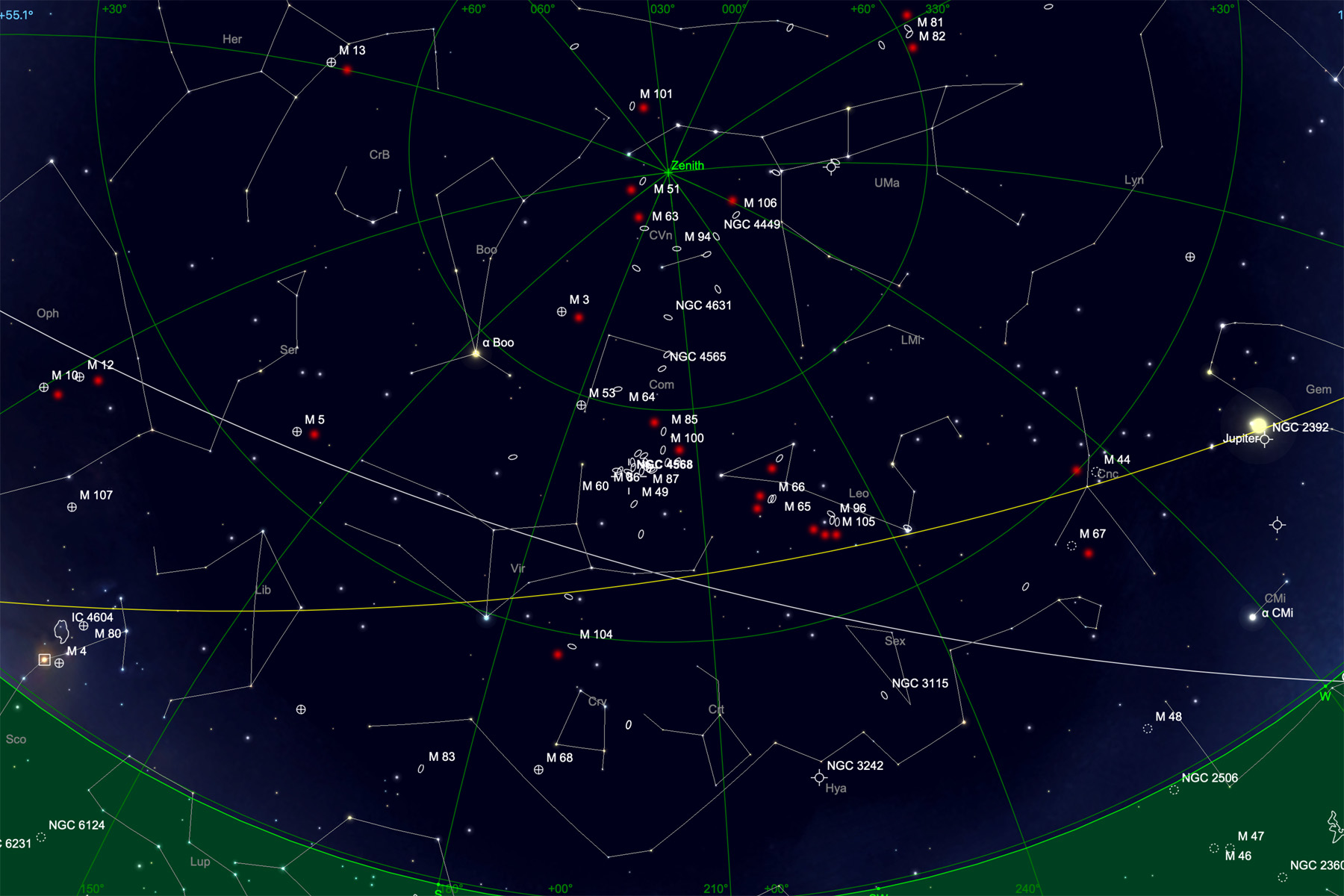
Click the map for a larger version - it opens in a new window (Image Courtesy of SkySafari Astronomy, www.simulationcurriculum.com)
Observation Time
The observations in this phase took place from mid-April 2026 on. They typically took place shortly after dusk, when it was sufficiently dark for a successful initialization of the Dwarf mini. This was at about 9 p.m. in mid-April, later at 10 p.m. and even after 10 p.m..
Observation Location
The observations took place in Mühlhausen/Kraichgau (Germany):- Coordinates: 49° 15′ N , 8° 43′ E
- Coordinates (dec.): 49,25° N, 8,72° E
Equipment Used
When observing with the Dwarf mini, I only needed the Dwarf mini and my iPhone or iPad. When needed (e.g. for EQ mode), I used the DarfLab Tripod that I had bought together with the Dwarf mini. Filters are inbuilt (Astro, Dual Band, Dark) or delivered with the Dwarf mini (Solar Filter).
General Conditions
In general, the sky above Mühlhausen/Kraichgau is "light-polluted" (SQM 20.5) and does not invite you to search for deep sky objects. For astro photography, however, light pollution is not as disturbing as for visual observations.
Observation Overview
Observation Dates
Note: (15/60/Astro) means 15 s, Gain 60, Astro Filter - and analogeously...
| Date 2026 |
Observed Objects | Observed Objects, Details | Remarks | Further Remarks |
| Apr 22 MH |
G: M 95, M 96, M 105 OC: M 67 |
Order: M 67 (25 min), M 95/96/105 (25 min) |
Dwarf mini; iPad | M 67 with EQ (< 3°); from 9:55/19.48 p.m./SQM (15/60/Astro); stopped at 10:28 p.m. after 101 subs (25 min) M 96 (M 95, M 105) as 1:1,8 EQ mosaic from 10:40/19.8 p.m./SQM; stopped at 11:25 p.m. after 100 subs (25 min) |
| Apr 24 MH |
G: M 65, M 66, NGC 3628 | Order: M 65/66/NGC 3628 (60 min) |
Dwarf mini; iPad | M 65/66/NGC 3628 with EQ (< 1°); from 22:00/18.2 p.m./SQM (30/60/Astro); stopped at 11:20/18.9 after 120 subs (60 min |
| Apr 26 MH |
G: M 81, M 82 OC: M 35, M 36, M 37, M 38, NGC 1907*, NGC 2158 *) not in list |
Order: M 38 (with NGC 1907, 16 min), M 36 (15 min), M 37 (15 min), M 35 (with NGC 2158, 15 min), M 81/82 (with NGC 3077, 25 min) |
Dwarf mini; iPad | M 38 with EQ (1°); from 9:55/18.5 p.m./SQM (15/60/Astro); stopped at 10:14/18.3 after 65 subs (16 min) M 36 with EQ; from 10:20/18.3 p.m./SQM (15/60/Astro); stopped at 10:37/18.6 after 60 subs (15 min) M 37 with EQ; from 10:4/18.3 p.m./SQM (15/60/Astro); stopped at 11:03/18.2 after 63 subs (15 min) M 35 with EQ; from 11:05/18.2..6 p.m./SQM (15/60/Astro); stopped at 11:25/18.5 after 60 subs (15 min) M 81/82 with EQ; from 11:35/18.5 p.m./SQM (15/60/Astro); stopped at 00:04/18.2 after 101 subs (25 min) |
| May 7 MH |
G: M 84, M 86, NGC 4387/88, NGC 4402, NGC 4435 /38 | Order: |
Dwarf mini; iPad | M 86 (GGG, further galaxies) with EQ; from 10:55/20.2 p.m./SQM (30/60/Astro); stopped at 00:05/18.9 a.m./SQM after 120 subs (60 min) FOV moved so that NGC 4435 (The Eyes) was located at the center (nearly perfect...) In the beginning, nothing worked, the target was not at all approached, the dark frames were not found. Only after a restart of the telescope, everything worked normally. |
| May 9 MH |
G: M 58, M 59, M 60, NGC 4564, NGC 4565, NGC 4567/68 | Order: NGC 4564 (with NGC 4567/8, M 58, 31 min), M 60 (withM 59, M 58, 30 min), NGC 4565 (30 min) |
Dwarf mini; iPad | NGC 4567/8 (Siamese Twins + M 58; centered on NGC 4564) with EQ (0°)!; from 10:25/19.5 p.m./SQM (30/60/Astro); stopped at 11:05/19.9 after 62 subs (31 min) M 60 (M 59, M 58; center of M 60 moved) with EQ; from 11:10/20 p.m./SQM (30/60/Astro); stopped at 11:52/20 after 61 subs (31.5min) NGC 4565 with EQ; from 11:55/20 p.m./SQM (30/60/Astro); stopped at 0:32/20.1 after 60 subs (30 min) EQ adjusted to exactly 0° (for the very first time)... |
Bold: First observation during this observation period; G = galaxy, OC = open star cluster, GC = globular star cluster, GN = galactic nebula, PN = planetary nebula, SP = star pattern, DN = dark nebula, C = comet, SN = supernova, SR = supernova remnant; IT = integration time (net observation time)
List of Observed Sky Objects
Object details can be obtained via the links to the relevant deep sky objects.
|
DSO Details
|
Name | Constellation | Type | Remarks |
| M 35 | with NGC 2158 | Gemini | OC | Nice open star cluster, together with NGC 2158 |
| M 36 | Auriga | OC | Nice open star cluster, the smallest of M 36-38 | |
| M 37 | Auriga | OC | Nice open star cluster, the densest of M 36-38; NGC 1907 is nearby | |
| M 38 | with NGC 1907 | Auriga | OC | Nice open star cluster, the largest of M 36-38; with M 36 in a mosaic |
| M 58 | with NGC 4567/68; alternatively with M 59 and M 60 | Virgo | G | Barred spiral galaxy, together with the spiral galaxies NGC 4567/68 (Butterfly Galaxies) |
| M 59 | with M 58 and M 60 | Virgo | G | Elliptical galaxy; can be seen together with M 60 and M 58 |
| M 60 | with M 58 and M 59 | Virgo | G | Elliptical galaxy with satellite NGC 4647 (spiral galaxy); both form the galaxy pair Arp 116; are also on some of the photos; M 60 can be photographed together with M 59 and M 58. |
| M 65 | with M 66 and NGC 3628 | Leo | G | Thin, elongated spiral galaxy, spiral hard to see; part of the Leo triplet (with M 66 and NGC 3628); with Dwarf mini the whole triplet can be observed. |
| M 66 | with M 65 and NGC 3628 | Leo | G | Elongated spiral galaxy, spiral visible; part of the Leo triplet (with M 65 and NGC 3628); with the Dwarf mini the whole triplet can be observed. |
| M 67 | Cancer | OC | Large, nice cluster with a few bright stars and many not so bright ones | |
| M 81 | with M 82 and NGC 3077 | Ursa Major | G | Nice spiral galaxy; the spiral is not very conspicuous in the eVs; can be seen together with NGC 3077 and M 82 in the Dwarf mini.. |
| M 82 | with M 81 and NGC 3077 | Ursa Major | G | Elongated irregular galaxy (cigar), disturbed by an encounter with M 81; can be seen together with M 81 and NGC 3077 in the Dwarf mini. |
| M 84 | Great Galactic Face, Markarian's Chain | Virgo |
G | Elliptical galaxy that can be seen together with M 86 (+ NGC 4387 and NGC 4402); forms together with M 86 and NGC 4387 the "Great Galactic Face". Accessed via NGC 4435. Many more galaxies on the photo. |
| M 86 | Great Galactic Face, Markarian's Chain | Virgo | G | Elliptische Galaxie, die zusammen mit M 84 gesehen werden kann (+ NGC 4387 und NGC 4402); bildet mit M 84 und NGC 4387 das "große galaktische Gesicht". Accessed via NGC 4435. Many more galaxies on the photo. |
| M 95 | with M 96 and M 105 | Leo | G | Small barred spiral galaxy, relatively faint, but the bar is visible. Forms a pair with M 96. M 96 and M 105 can be included in a Dwarf mini mosaic. |
| M 96 | with M 95 and M 105 | Leo | G | Spiral galaxy, forms a pair with M 95. M 95 and M 105 can be included in a Dwarf mini mosaic. |
| M 105 | with NGC 3384/89 as well as M 95 and M 96 | Leo | G | Bright elliptical galaxy; close to the galaxies NGC 3384 (elliptical) and the smaller NGC 3389 (spiral). In a Dwarf mini mosaic also together with M 95 and M 96 |
| NGC 2158 | Close to M 35 | Gemini | OC | Close to M 35 and can be seen together with it in the Dwarf mini |
| NGC 3077 | close to M 81 (and with M 82) | Ursa Major | G | Small companion of M 81 |
| NGC 3628 | Hamburger Galaxy, with M 65 and M 66 | Leo | G | Spiral galaxy seen edge-on; it forms a conspicuous group with M 65 and M 66, the Leo Triplet (Arp 317, Holm 246). |
| NGC 4387 | Great Galactic Face; see also M 84/86 | Virgo | G | Three small galaxies close to M 84 and M 86. NGC 4387 is a small elliptical galaxy and the nose of the "Great Galactic Face"; NGC 4388 is a spiral galaxy, and forms the mouth; NGC 4402 is a spiral galaxy on top of the GGF. |
| NGC 4388 | G | |||
| NGC 4402 | G | |||
| NGC 4435/38 | The Eyes | Virgo | G/G | The lenticular galaxies NGC 4435 and NGC 4438 are also called "The Eyes" or "Markarian's Eyes". They can be taken as the starting point for a mosaic of Markarian's chain (from NGC 4477 to M 84) (more precisely: NGC 4435). |
| NGC 4564 | with NGC 4567/68 and M 58 | Virgo | G | Elliptical galaxy; center for photographing NGC 4567/68 and M 58 |
| NGC 4565 | Needle Galaxy | Coma Berenices | G | One of the most prominent and famous edge-on spiral galaxies in the sky; together with NGC 4562 and NGC 4494, NGC 4565 forms the small galaxy group LGG 294. |
| NGC 4567/68 | Siamese Twins//Butterfly Galaxies | Virgo | G/G | Strongly interacting spiral galaxies NGC 4567/68, together with the barred spiral galaxy M 58 |
G = galaxy, GaC = galaxy cluster, OC = open star cluster, GC = globular star cluster, GE = galactic emission nebula, GR = galactic reflection nebula, DN = dark nebula, C = comet, PN = planetary nebula, SP = star pattern, A = Asterism, SR = Supernova remnant, HII = HII region (emission nebula in other galaxies)
References
Books
- Michael Feiler & Philip Novak (2023). Deep Sky Reiseatlas (5th edition), Oculum Verlag (ISBN 978-3-949370-04-5)
www.oculum-verlag.de/detailview?no=608 - Ronald Stoyan (2021). Deep Sky Reiseführer (6th edition), Oculum Verlag (ISBN: 978-3-938649-72-9)
www.oculum-verlag.de/detailview?no=603 - Erich Karkoschka (2022). Atlas für Himmelsbeobachter, Kosmos Verlag (EAN: 9783440173602)
www.kosmos.de/de/atlas-fur-himmelsbeobachter_1074889_9783440173602
On this Website
- My Deep Sky Observations with the Dwarf mini (Complete List of Observed DSO)
- Dwarf mini - Information
|
made by  on a mac! on a mac! |


| 13.09.2026 |  |