

DwarfLab Dwarf mini - EQ Mode
Introduction | Hint: Orientation of the Telescope on the Tripod | Preparing the Telescope and Tripod for the EQ Mode | First Examples | First Conclusions | Links
On this page, I describe the EQ mode for my electronic refractor telescope Dwarf mini 30 mm/150 mm (f/5).
See also:
- Information
- Tripod
- Bag
- EQ Mode (this page)
- First Experience
- Mosaic Mode
- Observations of the Sun
- Observations of the Moon
- Observations with Filter
- >> My Deep Sky Observations with the Dwarf mini (Complete List of Observed DSO)
- Photo Gallery (Messier) - Photo Gallery (Other) - Galaxies - Nebulae - Open Star Clusters
- Photo Comparison (with Vaonis Vespera)
Introduction
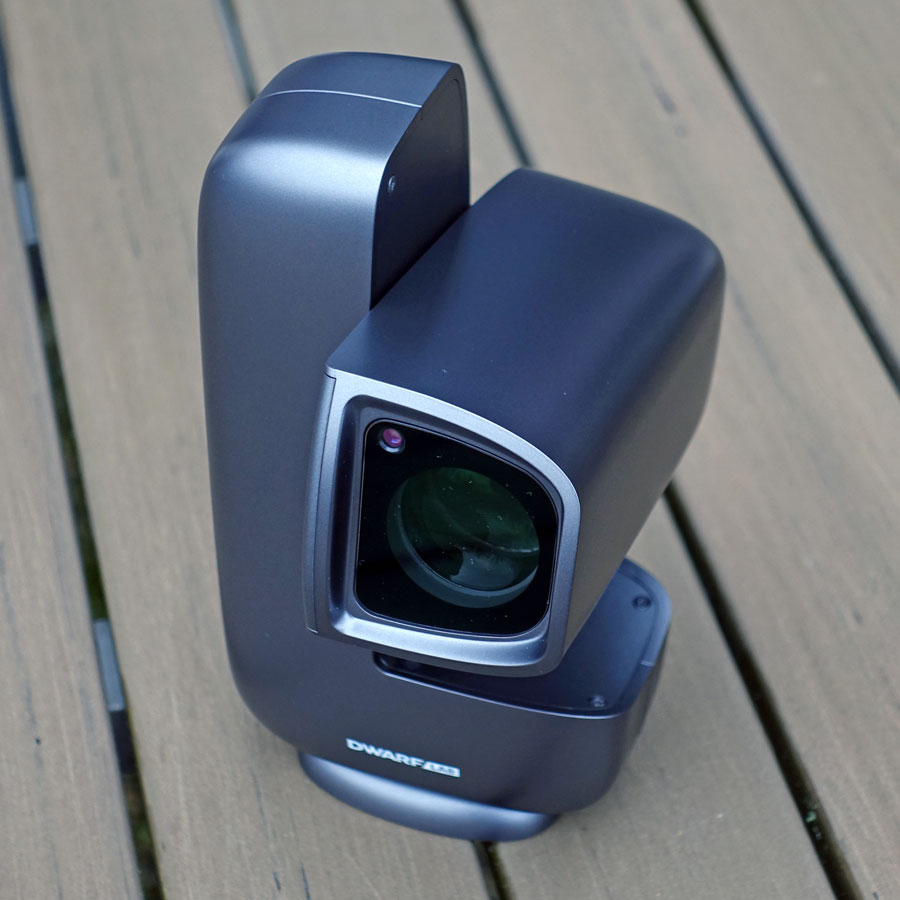 |
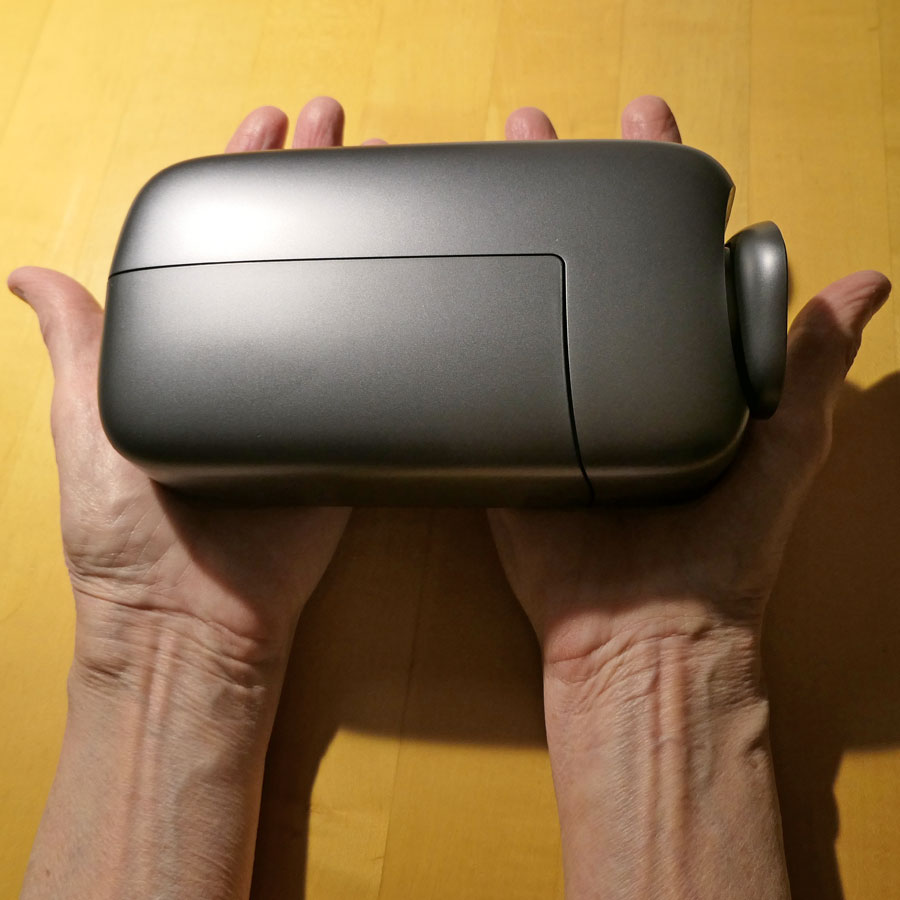 |
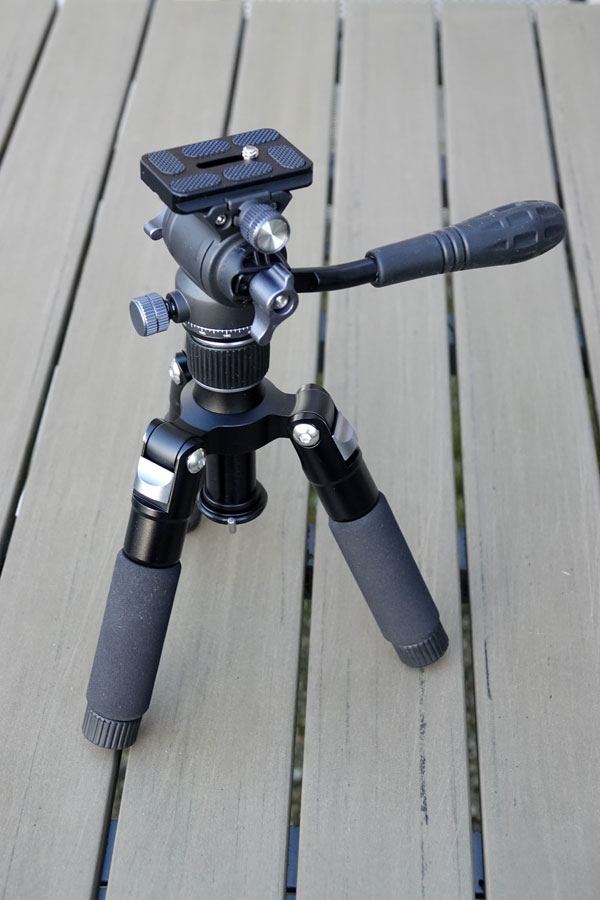 |
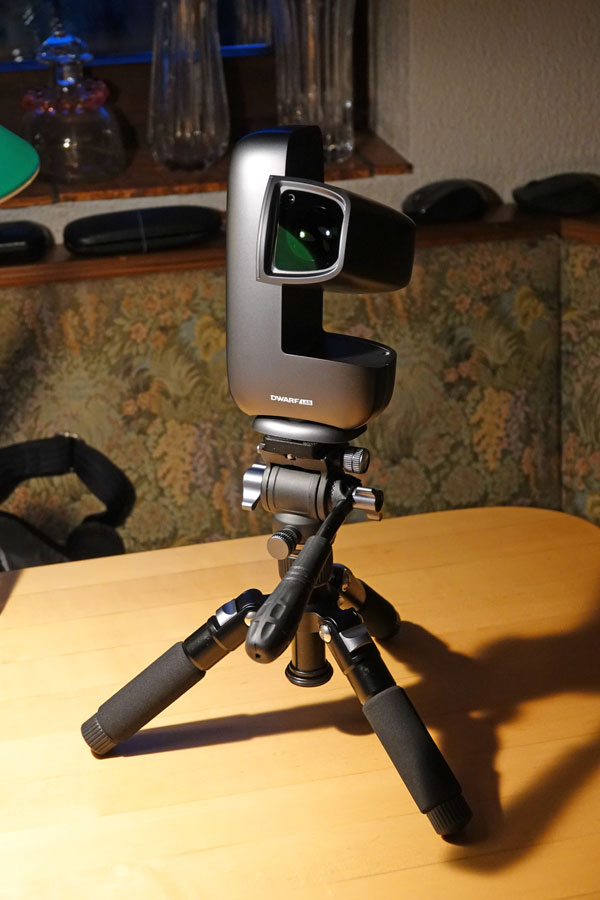
Photo: My Dwarf mini and its tripod (Jan 2026)
The Dwarf mini is normally operated in AZ mode. However, it can also be operated in EQ mode, which offers the following advantages:
- More stable tracking because only one axis needs to be moved
- Longer exposure times (greater than 15 seconds and up to 90 seconds) can be used
- Less field rotation, so that the image does not need to be cropped, or hardly at all, during observation
For EQ mode, the Dwarf mini must be operated on a tripod such as the DwarfLab tripod. More information on this tripod on page Tripod.
In addition, EQ mode has to be be used when capturing mosaics with the Dwarf mini. More information on mosaics on page Mosaic Mode.
The telescope is prepared for EQ mode in two steps:
The next section can also be skipped to go straight to the preparations.
Hint: Orientation of the Telescope on the Tripod
This section can be skipped, in order to move directly to the preparations.
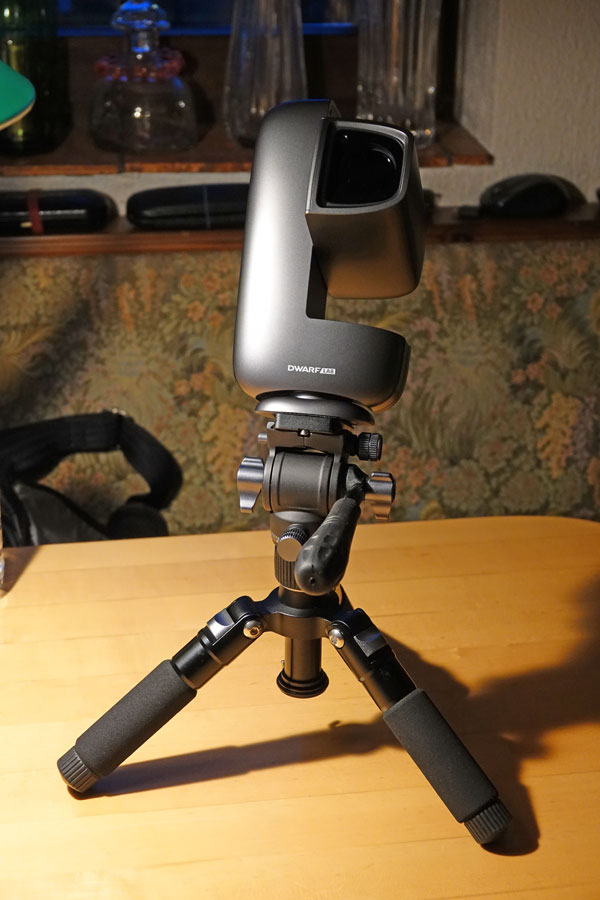
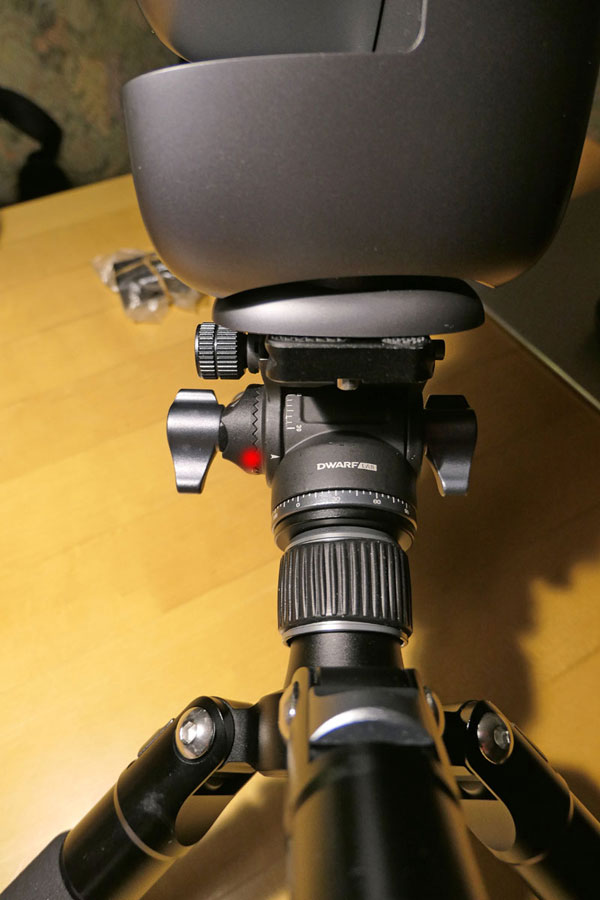
For EQ mode, the Dwarf mini must be mounted on a tripod such as the DwarfLab tripod. There are two ways to orient the Dwarf mini on the tripod, but only one of them is shown in photos and videos from DwarLab. However, this orientation makes it difficult to read the AZ scale, which complicates the azimuth alignment of the telescope.
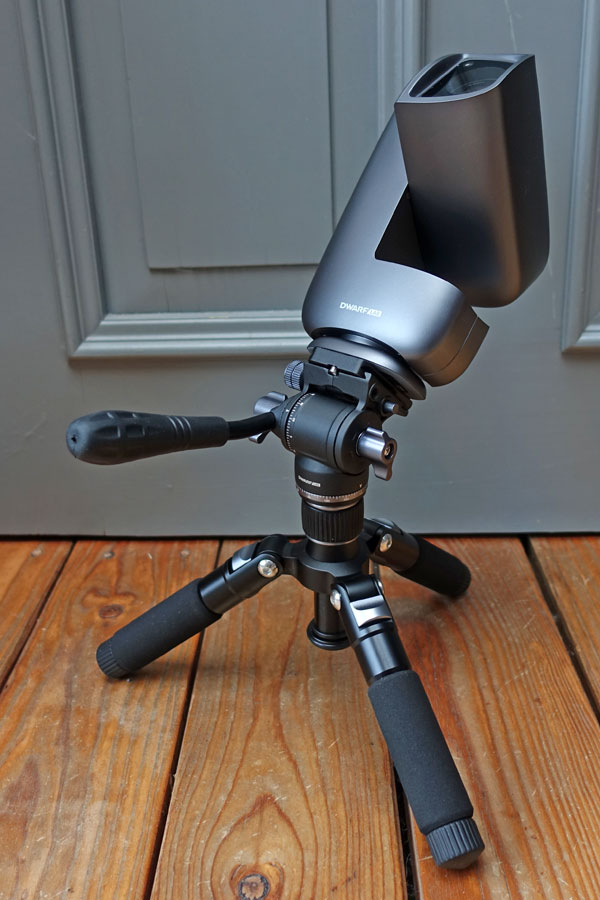
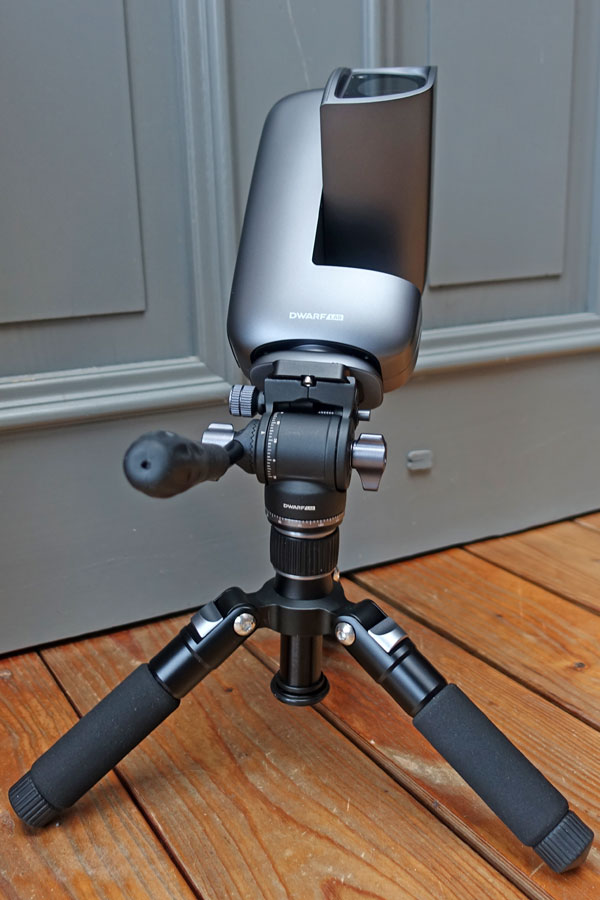
Alternatively, the Dwarf mini can also be mounted on the tripod in such a way that the AZ scale can be used. However, this option is not shown by DwarfLab. And if you mount the telescope in this way and let the handle point forward, it is bent upwards instead of downwards – but this should not really be a problem...
 |
 |
 |
||
Tripod set up according to the DwarfLab video for EQ mode, but the telescope is still horizontal, i.e. still in AZ mode |
Tripod set up according to the DwarfLab video for EQ mode |
The AZ angle cannot be identified in this setting! |
||
 |
 |
 |
||
Tripod set up opposite to the DwarfLab video for EQ mode |
Ditto |
The AZ angle can be identified in this setting! |
When I asked about orientation in a Facebook group, it became clear that different orientations are used successfully and that some users do not use/pay attention to the scale at all, but instead align the telescope by eye, especially since the app instructs you on how to align the telescope precisely. Consequently, orientation should not matter at all... On the advice of a fellow stargazer, I sent a query to DwarfLab about the orientation of the Dwarf mini on the tripod in EQ mode. As I had expected, the answer was that it does not matter.
My query:
- How do I mount the mini on the tripod correctly for EQ mode?
When I mount the mini as shown in the video, I cannot use the azimuth scale; other users mount it 180 degrees turned and can see the scale. What is correct? As far as I see it, it does not matter how the mini is mounted??
Here is the answer from DwarfLab:
- The mounting orientation of the Mini itself does not affect EQ mode operation.
What’s important is that the Mini is aligned toward true north and tilted to the correct latitude angle.
The azimuth scale is only a visual reference to help with alignment, and whether it is visible depends on how the Mini is mounted, but it does not impact tracking performance.
In other words: It does not matter how you mount the Dwarf mini on the telescope, everyone can do it according to their own preferences...
Preparing the Telescope and Tripod for the EQ Mode
The tripod and the telescope are prepared for EQ mode in two steps:
- Aligning the tripod and telescope for EQ mode (pure mechanically and using a compass)
- Correcting the alignment using the app
DwarfLab demonstrates in a (for me too fast) video how both steps can be accomplished (the first one can be done in daytime):
- DWARF mini EQ Mode Setup Guide: https://help.dwarflab.com/en/docs/dwarf-mini-equatorial-setup-guide?product=dwarf-mini
I therefore do not intend to write much about the setup here. But here are a few remarks on things that I noticed and some experiences...
Aligning the Telescope and Tripod for the EQ Mode
First, a few comments on the purely mechanical alignment of the tripod and the telescope! As already written, these steps can be carried out during the day where you can see everything better, especially the scales.
Angle and arrangement of the legs: I would not set the tripod legs at a steep angle, because the tripod can easily tip over in EQ mode due to the slanted position of the telescope, especially if the legs are not extended at all or only slightly. Instead, I would set the angle to the middle position or even set the legs flat if necessary (but then the center column must be pulled up). DwarfLab also recommends positioning one leg in the direction of the telescope's inclination to increase stability.
Compass/North alignment : In the video, DwarfLab uses a smartphone to align the telescope to the north. Well, maybe they have never heard of magnetic declination ;) But in the next step, the telescope is fine-tuned using the app for EQ mode, which should eliminate possible such and other errors...
If you always set up your telescope in the same place, over time you will know where north is roughly ;)
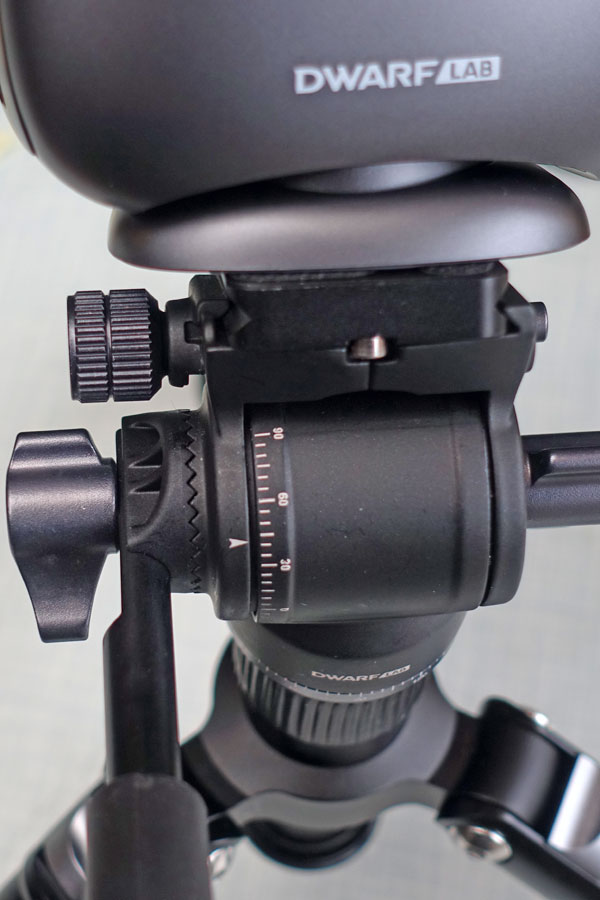
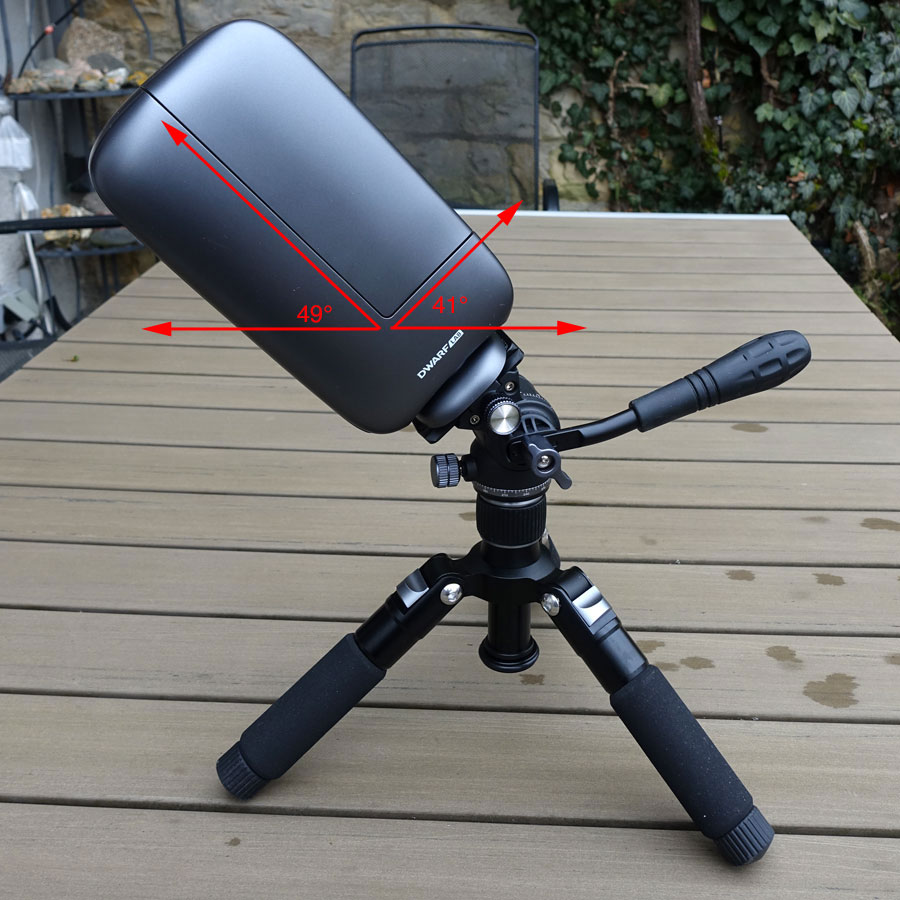
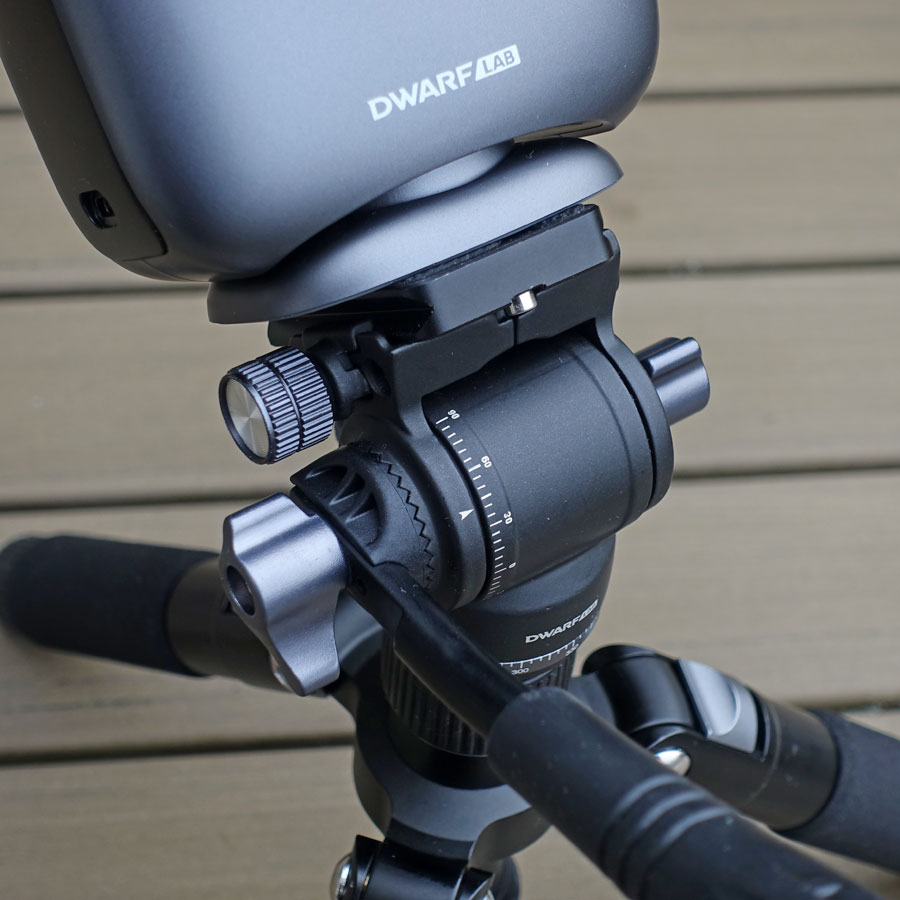
Tilt of the telescope head/Geographic latitude: The telescope head must be tilted so that the angle of inclination corresponds to the geographic latitude (see photo).
Depending on the orientation of the telescope on the tripod (see here), this can be read off the angle scale of the telescope head, at least roughly (or not). This is what I thought! But that is not true, you have to tilt the telescope backwards by 90° minus the geographical latitude! This is the only way to get the correct angle of inclination. I had not thought about that at first, but somehow got it right during the correction... The DwarfLab video helped me clarify that in the end (at first I always missed the crucial part because it was so quick...).
 |
 |
|
Dwarf mini on the tripod tilted 41° backwards; its vertical axis of rotation points to the celestial pole with a tilt of 49° (geographic latitude); the telescope has to be rotated clockwise for 90° for proper operation! |
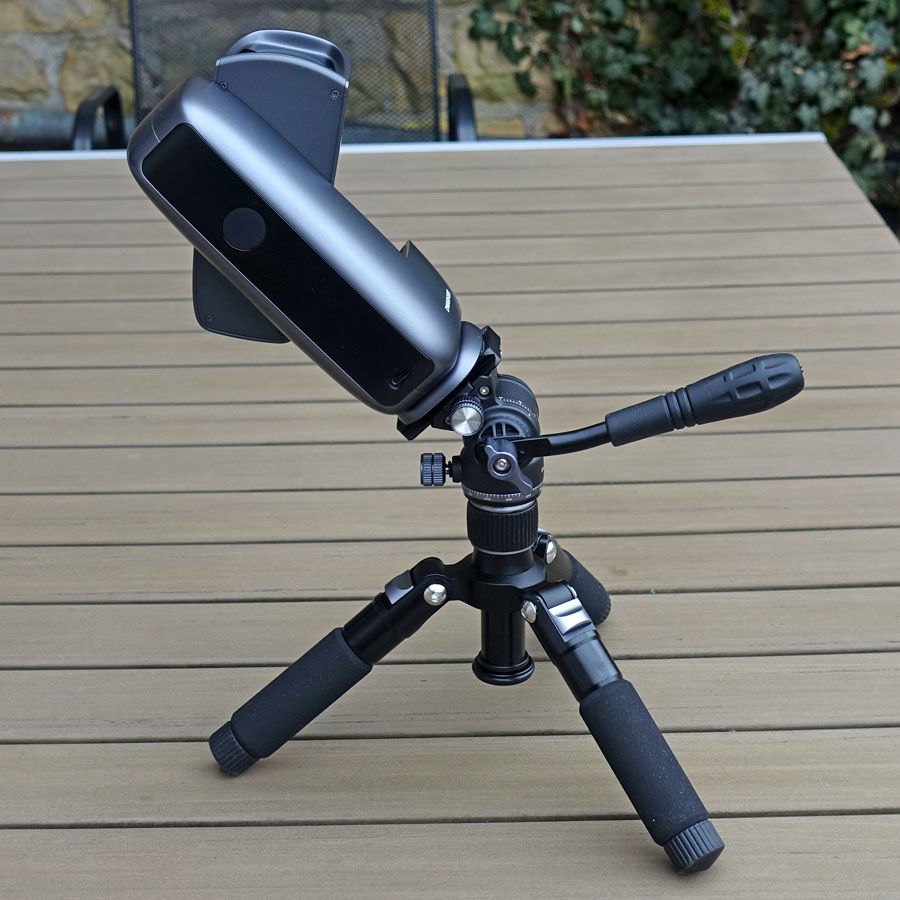
Dwarf mini on the tripod tilted 41° backwards (with leg for stability), telescope now pointing in the correct direction... | |
 |
 |
|
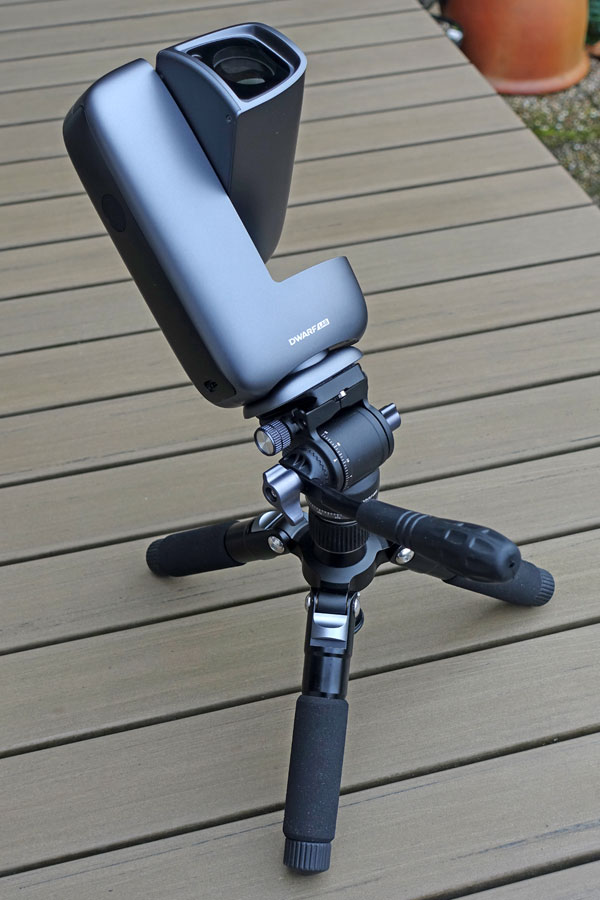
Dwarf mini on the tripos tilted 41° backwards, oblique view; "Dwarf mini" pointing forward (in the direction of the handle) |
Close-up of the angle scale; it shows an angle of about 40° (90° - geografic latitude) |
You can also make the setting by eye, especially since you can correct it afterwards using the app. In Germany it is particularly easy because you can set around 45° (here it is 49° N), which can be easily estimated. You can then make fine adjustments using the app if necessary (up to 3° deviation is accepted).
In Germany, you can set it to approximately 45° (here it is 49° N), which is easy to estimate, and then make fine adjustments using the app.
 |
 |
|
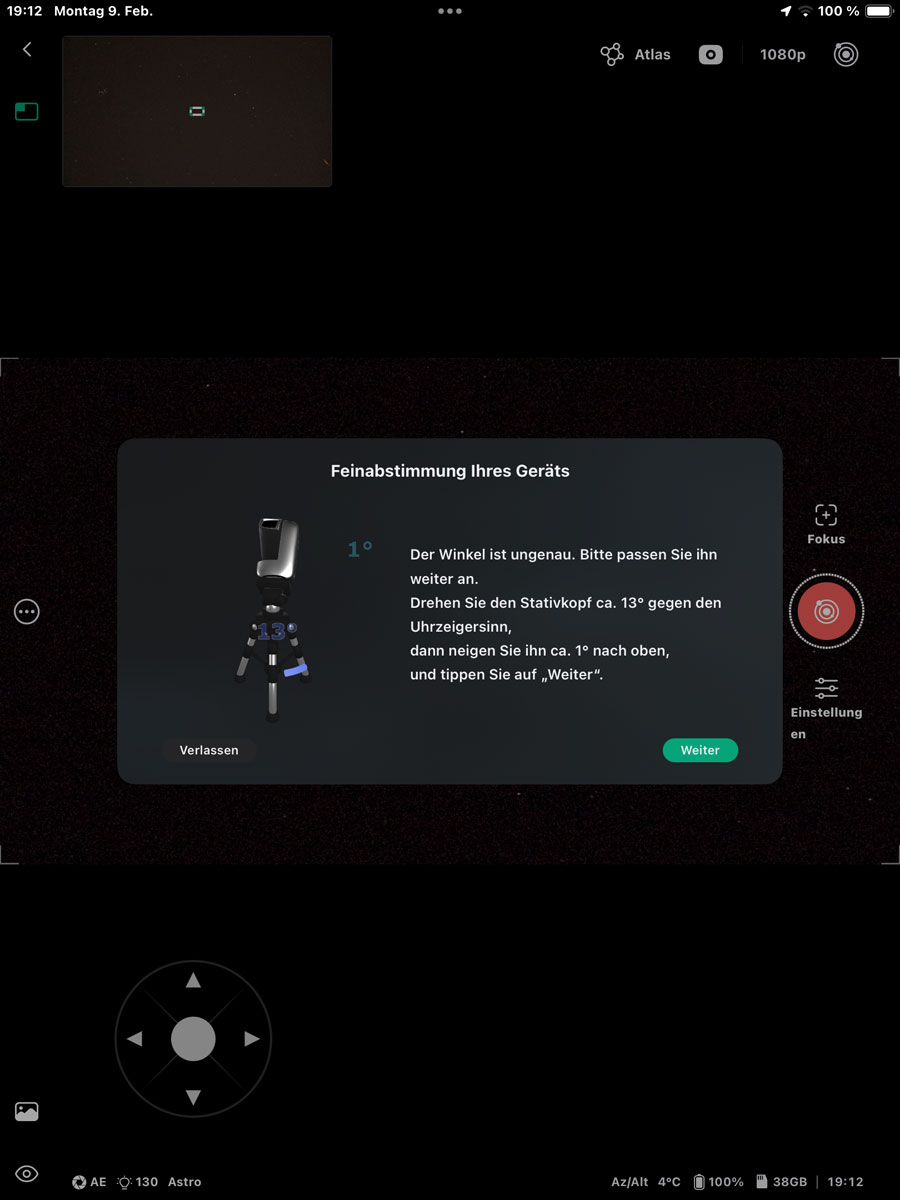
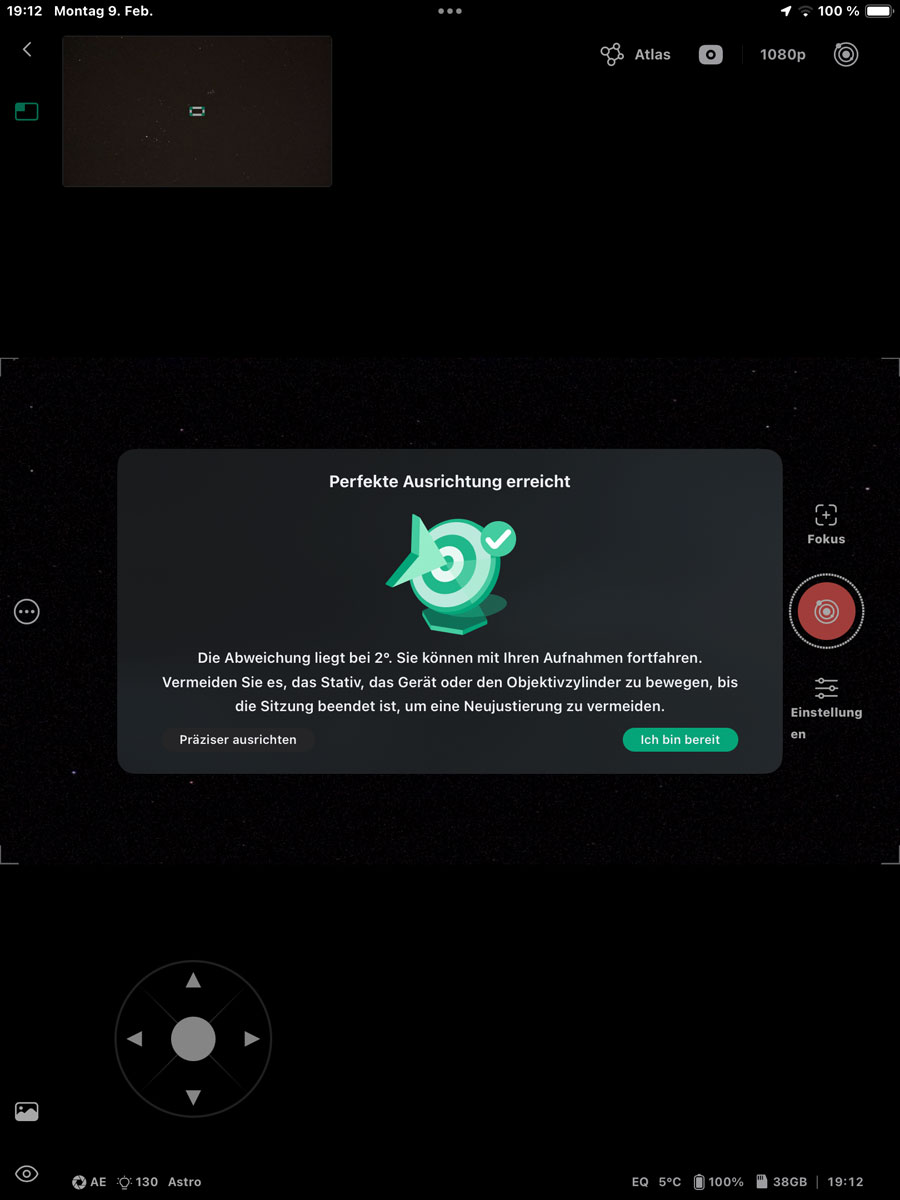
Instructions for the correction of the alignment in EQ mode |
The EQ mode is (nearly) perfectly set up, and the observation can start... |
By the way: If you orient the telescope so that you can see the angle scale (this is what I do...), the head will hit the locking knob for the horizontal axis at about 60° north latitude. So it is better to stay in Central Europe with this orientation ;) Or you should orient the telescops as shown by DwarfLab...
Adjusting the Alignment using the App
After setting up the tripod and telescope for EQ mode (tilt, alighning with true North), you can use the app to fine-tune the alignment. The app provides information on how many degrees the telescope needs to be corrected in relation to north alignment and the latitude angle. Given the lack of fine settings (and inaccurate or missing scales), this is quite fiddly and often requires several attempts for me... Up to 3° deviation is accepted on both axes; If you stay below this limit, the app reports that you can get started (but you can also optimize further...).
At first I found the instructions difficult to understand and also that they were somewhat contradictory for me. For example, the app reported that I need to tilt the telescope further upwards. When I did that, the error got even bigger. So I did not "obey" and corrected the latitude angle in the opposite way. That was how I managed to get the app's OK! I probably misinterpreted the instructions because no one on the internet has complained about it yet...
On the very first attempt I did not understand this and did not achieve correct alignment. I went ahead anyway and photographed two mosaics - and that apparently worked quite well... However, I expected that the app would not start the observation at all if the alignment was bad, but that was not the case ;) Later, I was able to start an observation although I had not aligned the telescope for EQ mode (it worked quite well, but I stopped the observation).
Initially, I always needed several corrections because I did not fully understand the whole thing and the correction was fiddly (especially in the dark). Since February 9, 2026, I believe that I have understood what the app wants to tell me when correcting the latitude angle - and that should eliminate all the problems that I had up to that date!
First Examples
Basically the EQ setup is brilliantly simple, except that I would like to have fine adjustments for both axes. It probably works so well because the Dwarf mini has a very short focal length and everything does not have to be that precise...
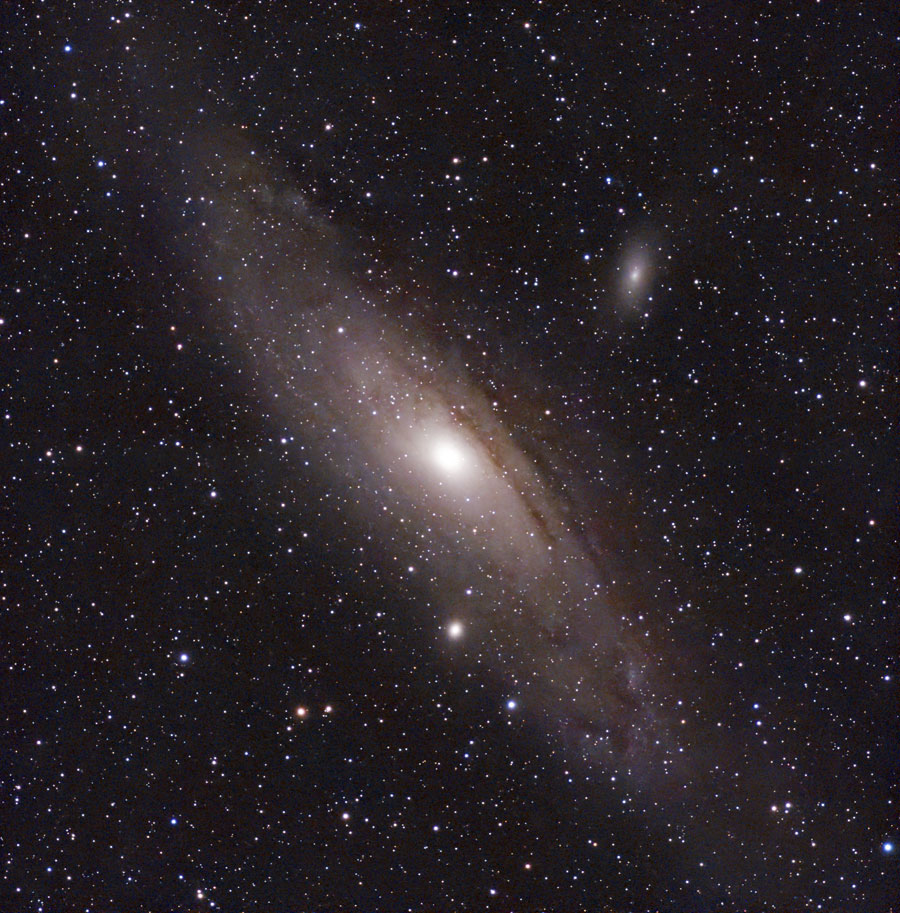
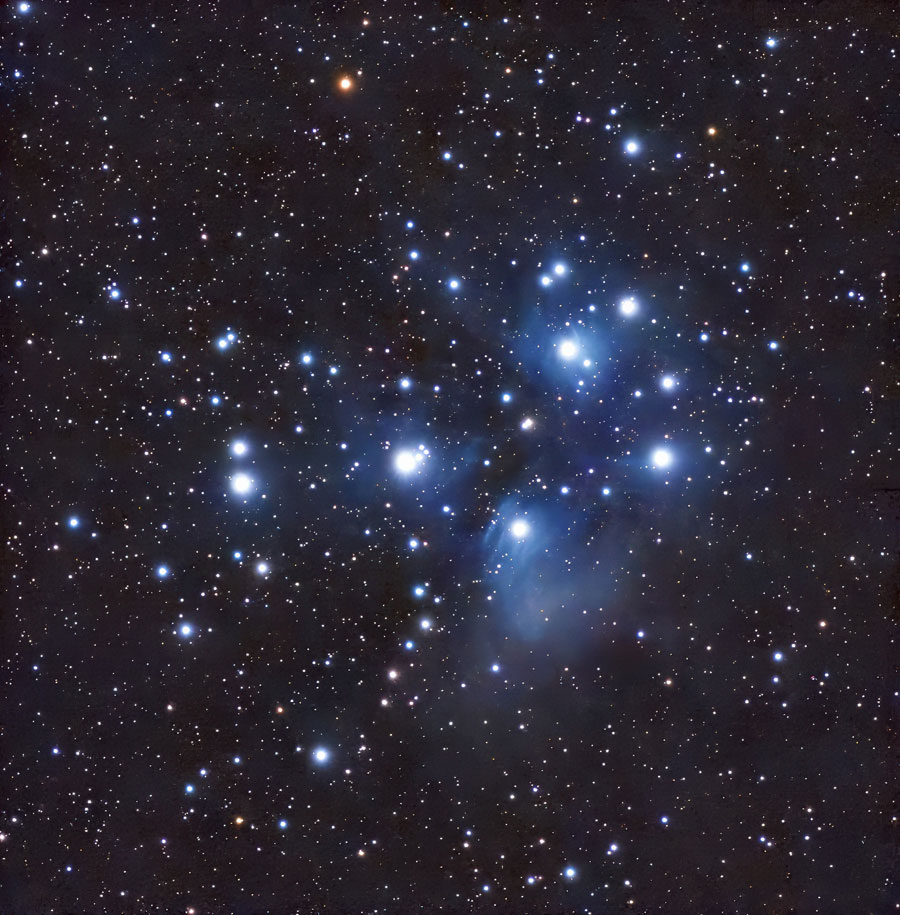
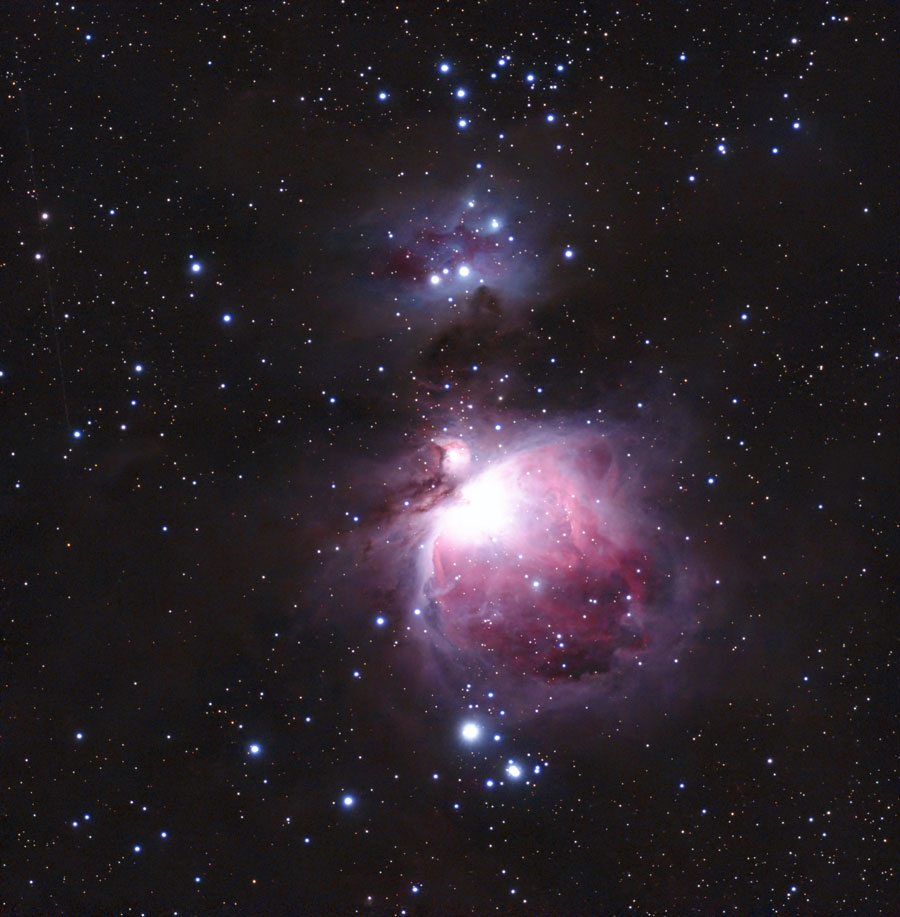
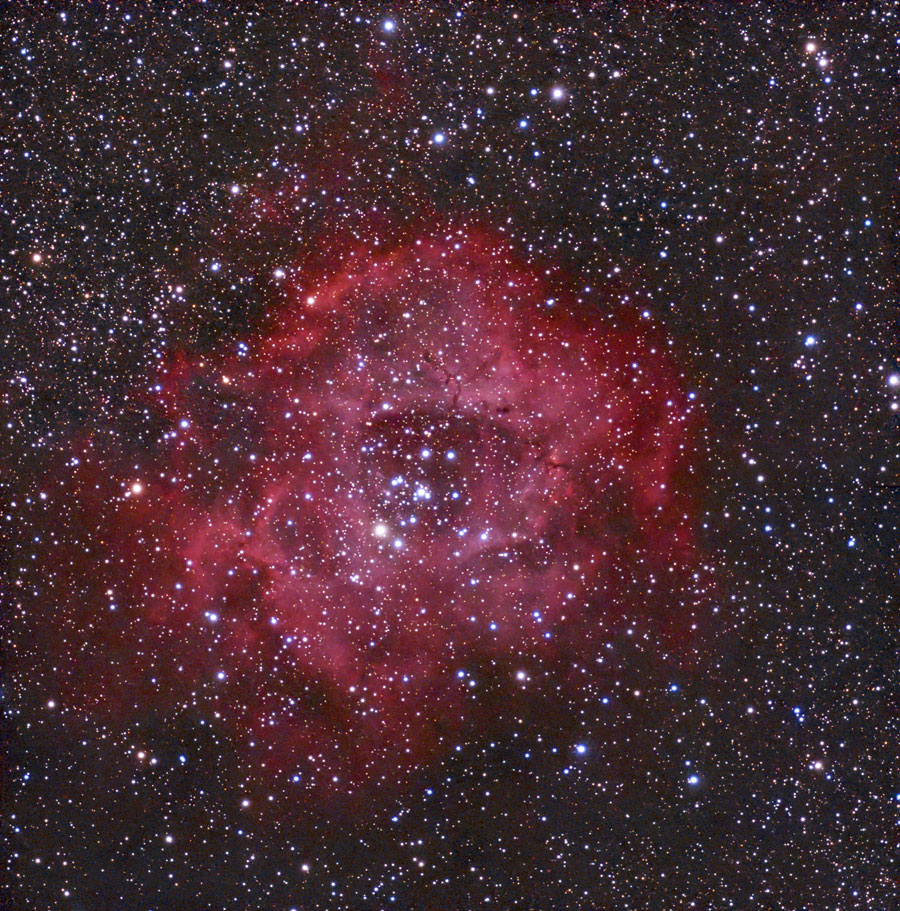
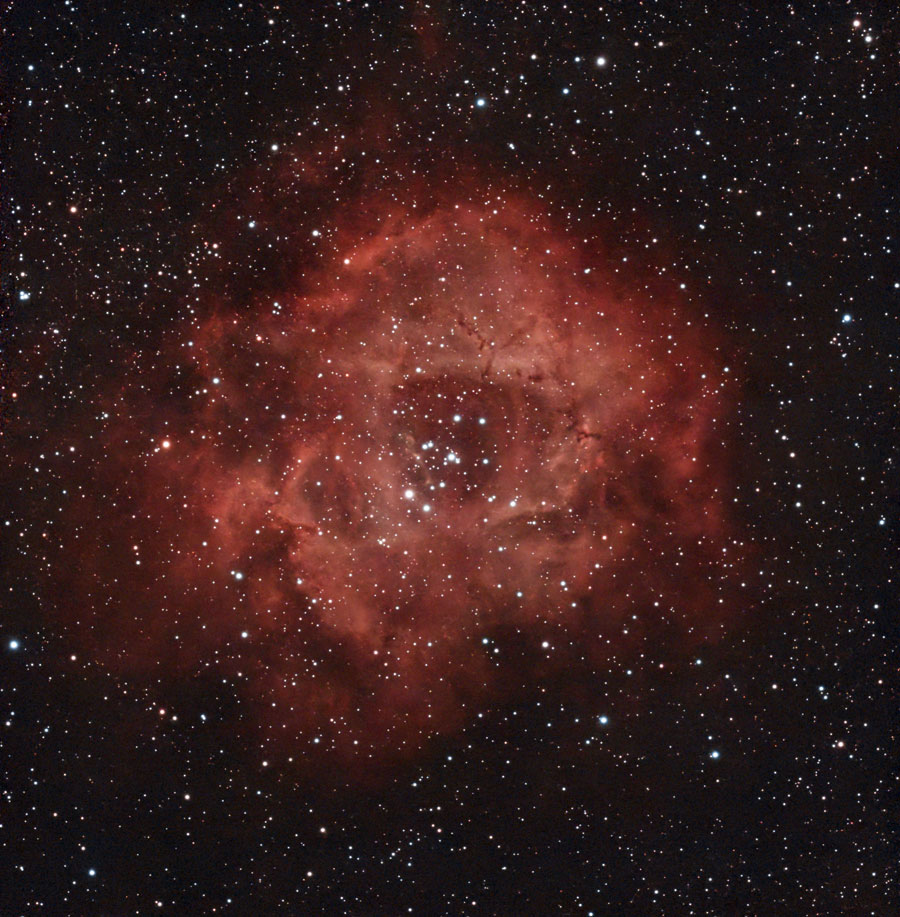
Up to March 2026, I only used the EQ mode together with mosaics; typically, I used 30s subs. Here are a few examples:
 |
 |
|
M 31, Feb 5, 2026 - 50 min, mosaic, processed with Stellar Studio, further processed, original |
M 45, Feb 5, 2026 - 50 min, mosaic, processed with Stellar Studio, additionally post-processed and denoised (TP), original |
|
 |
|
|
M 42/43, Feb 7, 2026 - 50 min, mosaic, processed with Stellar Studio, original |
M 42/43, Feb 26, 2026 - 50 min, mosaic, processed with Stellar Studio, DB filter, original |
|
 |
 |
|
NGC 2244, Feb 7, 2026 - 50 min, mosaic processed with Stellar Studio and additionally strongly processed, original |
NGC 2237/2244, Feb 9, 2026 - 50 min, DuoBand filter, mosaic, gain 120, processed with Stellar Studio and further post-processed, original |
|
 |
||
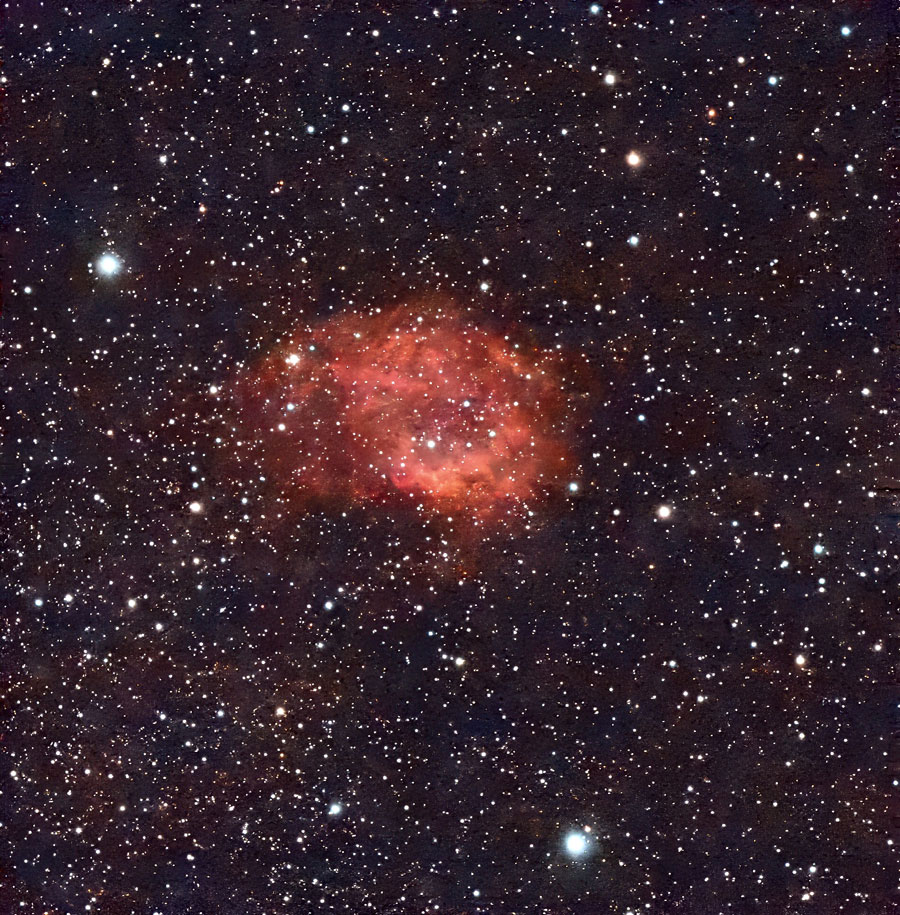
Sh2-261, 12.3.2026 - original (50 min), mosaic, DuoBand filter, processed with Stellar Studio and even further processed and denoised |
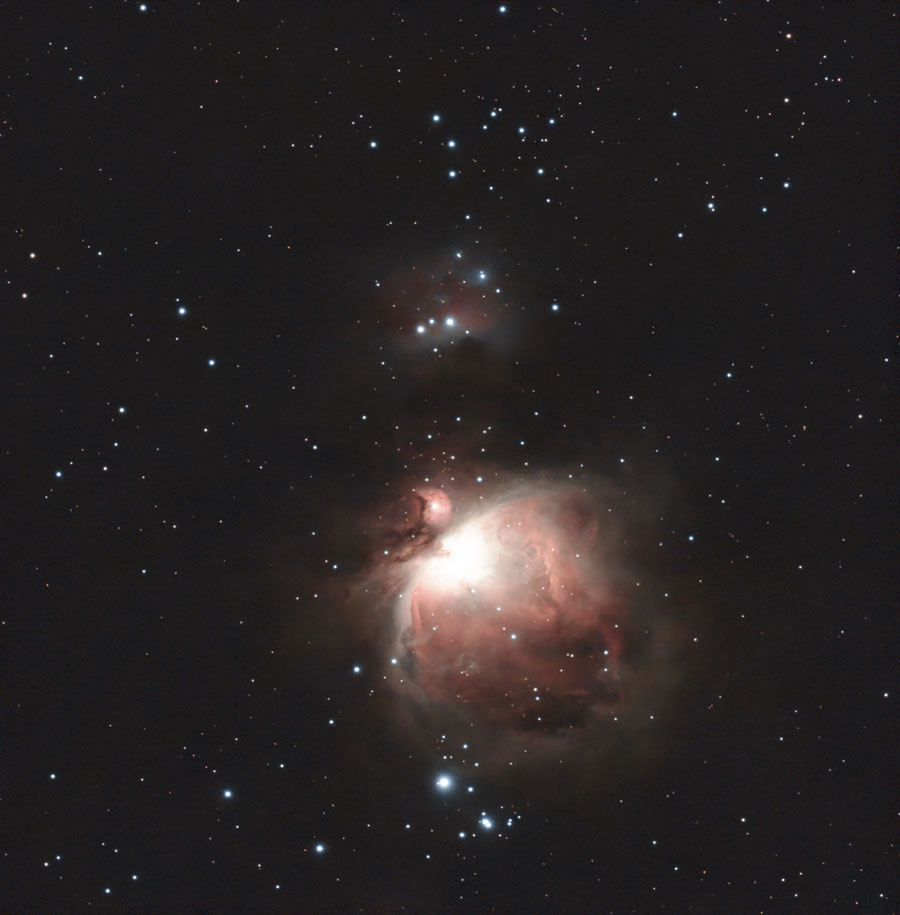
In the meantime, I have also captured a few DSOs in EQ mode in normal size. The advantages over AZ mode include less field rotation and the ability to use longer exposure times; typically, I used 30s subs.
 |
 |
|
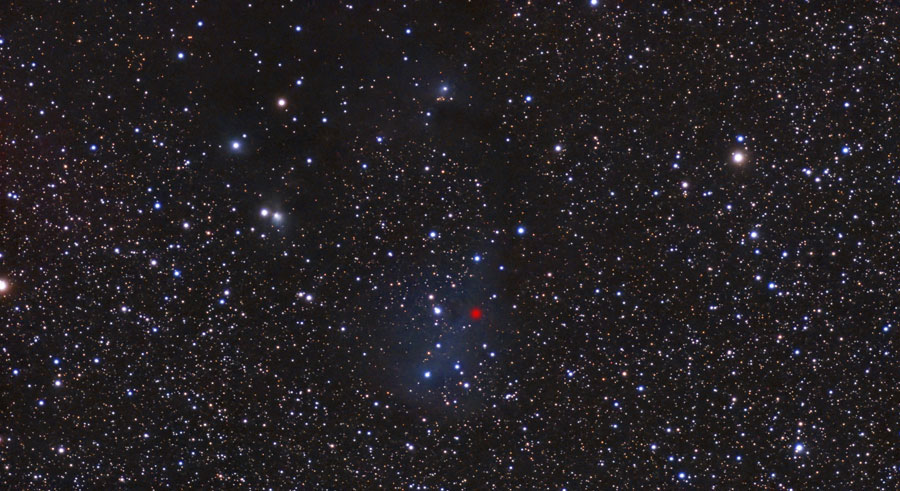
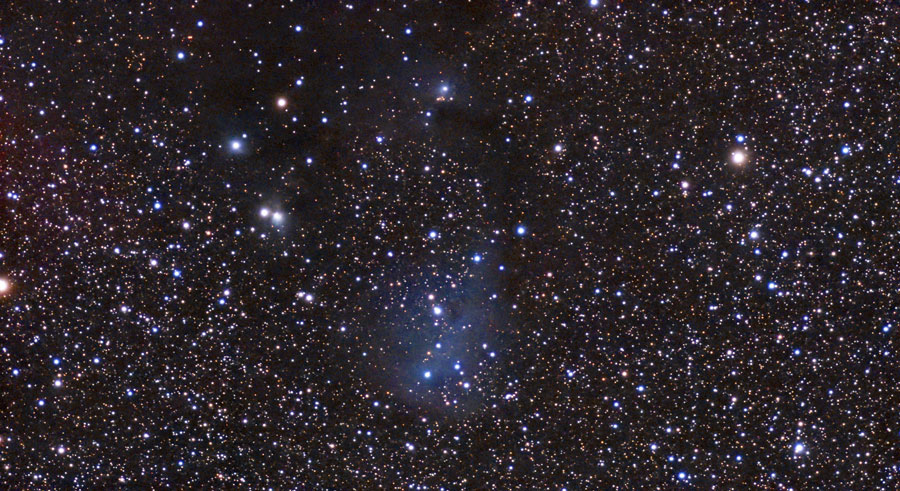
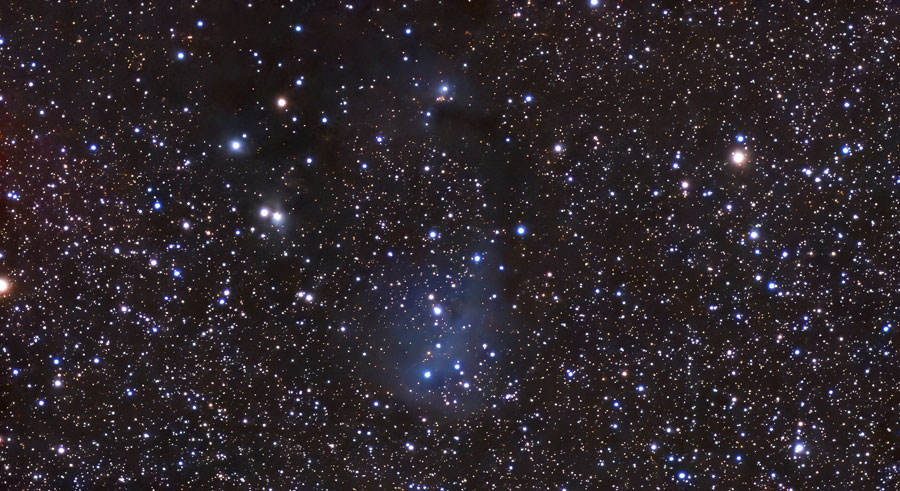
IC 447, Mar 19, 2026 - original, 2 h, processed with Stellar Studio |
IIC 447, Mar 19, 2026 - 2 h, processed with Stellar Studio, IC 2169 marked |
|
 |
 |
|
IC 447, Mar 19, 2026 - original, 2 h, processed with Stellar Studio and further processed |
IC 447, Mar 19, 2026 - original, 2 h, processed with Stellar Studio and further processed, denoised |
|
 |
 |
|
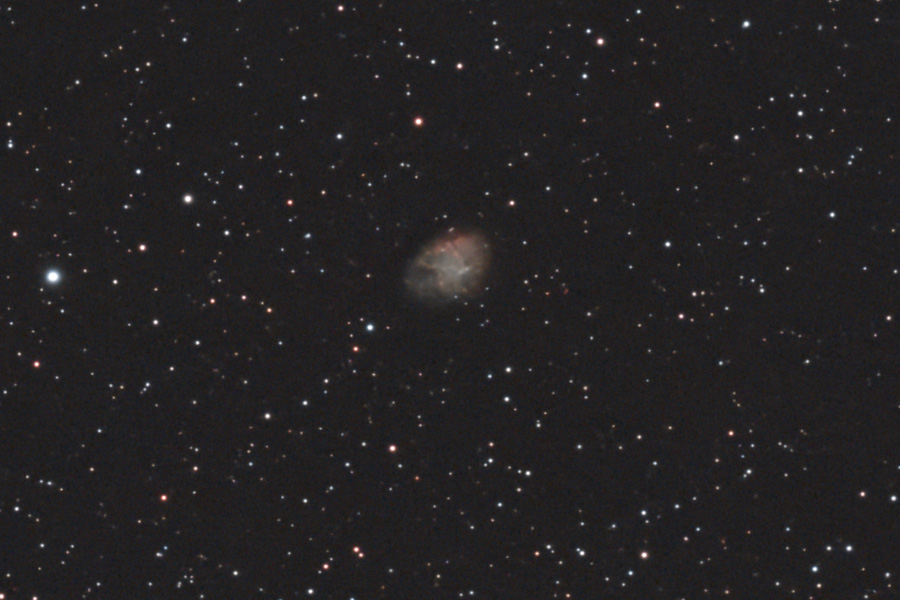
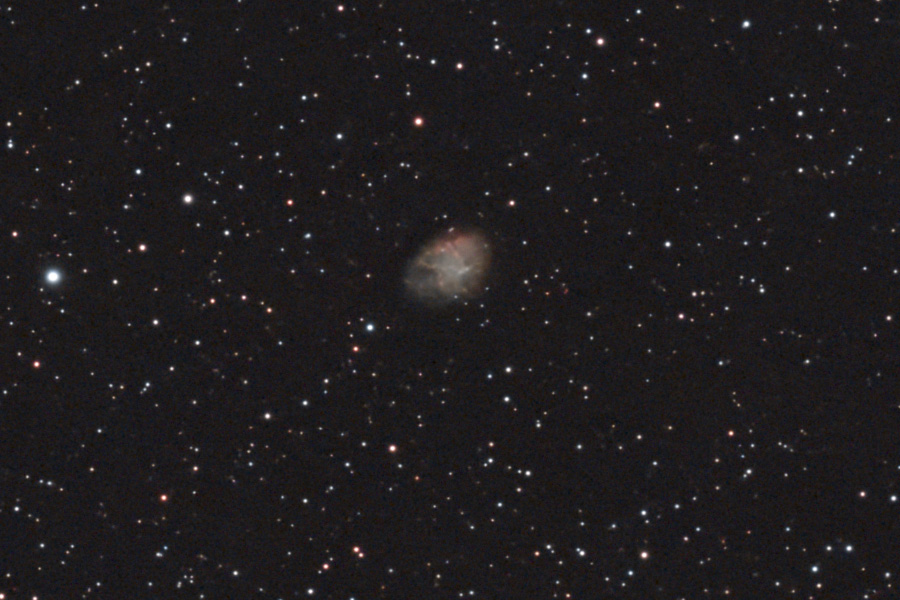
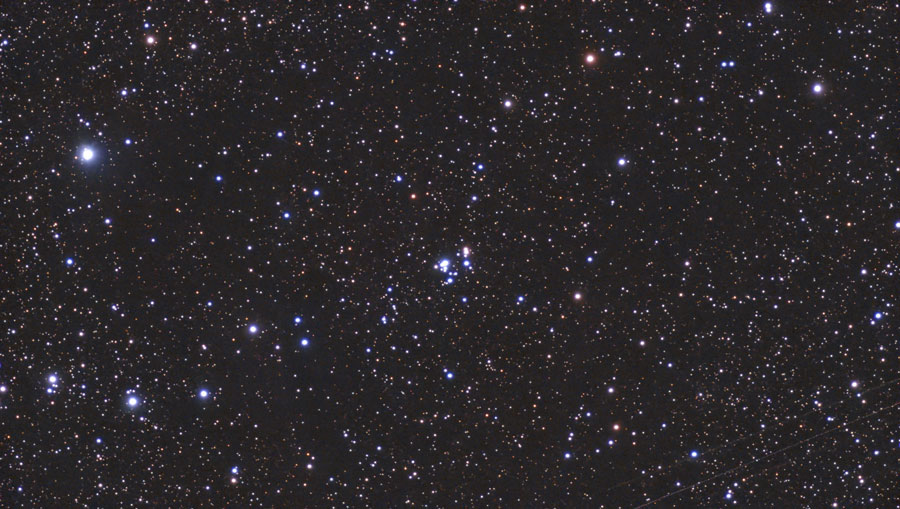
M 1, Mar 18, 2026 - 30 min, 1:1 section, DuoBand filter, processed with Stellar Studio |
M 1, Mar 18, 2026 - 30 min, 1:1 section, DuoBand filter, processed with Stellar Studio and post-processed |
|
 |
 |
|
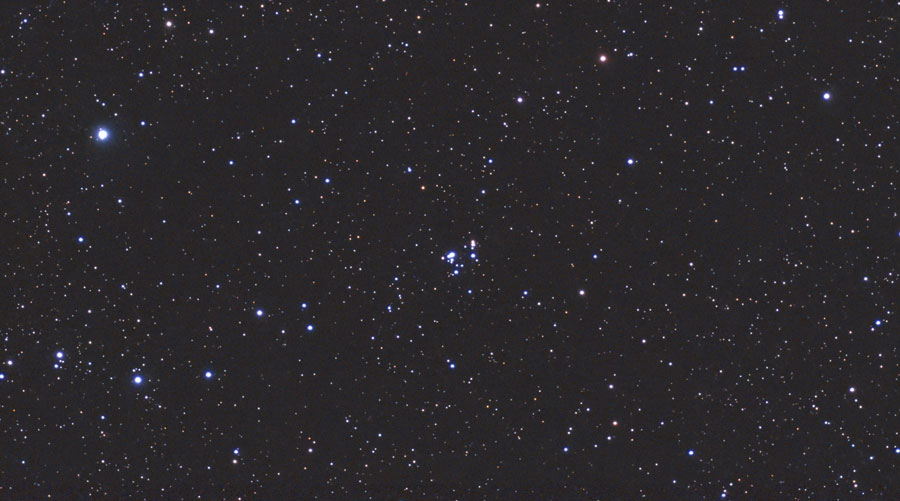
NGC 2169, Mar 18, 2026 - original, 4 min, processed with Stellar Studio |
NGC 2169, Mar 18, 2026 - original, 55 min, processed with Stellar Studio |
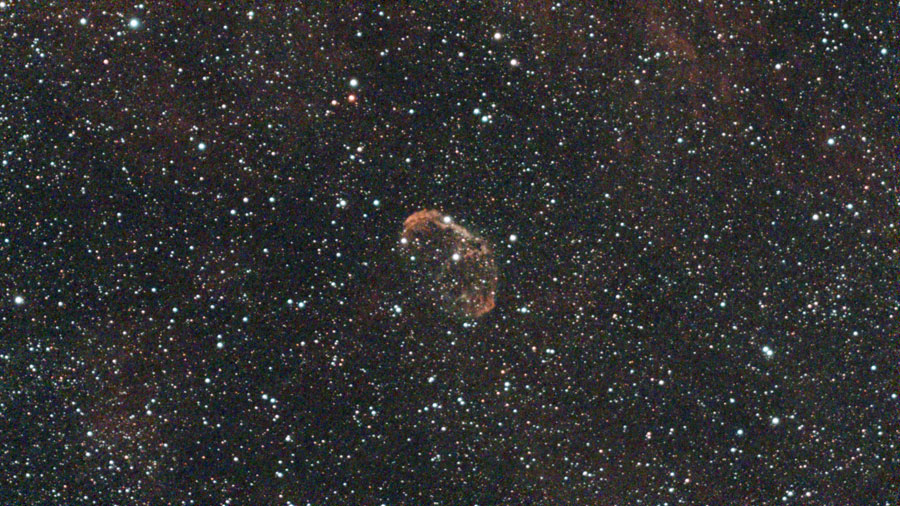
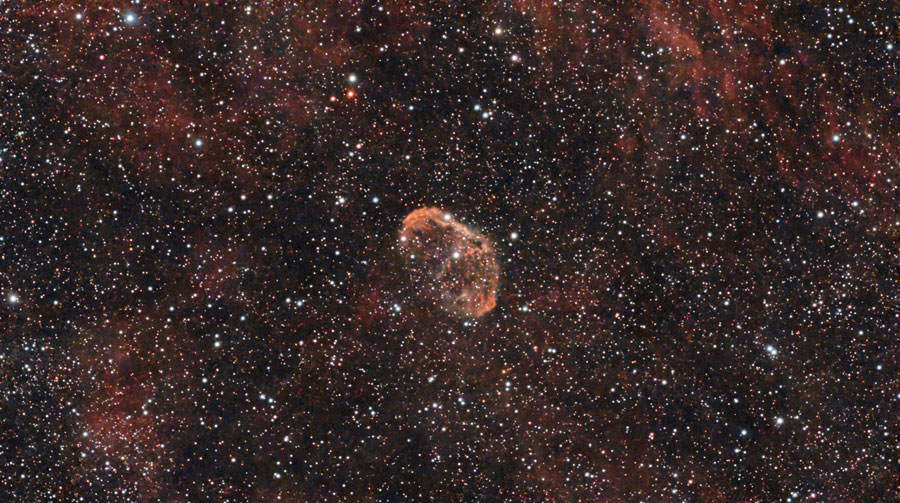
In September 2026, I photographed the Crescent Nebula NGC 6888 with 60s subs:
 |
 |
|
NGC 6888, Sep 11, 2026 - original (98 frames = 98 min) |
NGC 6888, Sep 11, 2026 - original (98 frames = 98 min), processed with Stellar Studio, post-processed, and then made brighter |
Of course, it would be interesting to compare EQ and AZ modes on specific objects with respect to field rotation and exposure times (same integration time, but different exposure times for the subs). But for this, I lack time and energy ;)
First Conclusions
Basically the EQ setup is brilliantly simple, except that I would like to have fine adjustments for both axes. The EQ mode probably works so well because the Dwarf mini has a very short focal length and everything does not have to be that precise...
While I first used only 30s subs, I photographed the Crescent Nebula NGC 6888 with 60s subs in September 2026 (after a long EQ break...).
Links
- Dwarf Mini Smart Telescope – Review & Tutorial (Wido's Astroforum): astroforumspace.com/dwarf-mini-smart-telescope-review-tutorial/ - YouTube-Video dazu: www.youtube.com/watch?v=4SoaQqLWR0s
- Dwarf Mini im Test: Das Technik-Wunder und Spaßgerät für die Hosentasche (Dimitrios Georgomanos): www.blickohnegrenzen.de/2026/02/06/dwarf-mini-im-test-das-technik-wunder-und-spassgeraet-fuer-die-hosentasche (in German)
- Dwarf mini documentation (DwarfLab): help.dwarflab.com/en/docs/dwarf-mini-smart-telescope
- DWARF mini User Manual: help.dwarflab.com/en/docs/DWARF-mini-Smart-Telescope-User-Manual
- Get to Know the Files Stored in DWARF mini: help.dwarflab.com/en/docs/help-doc
- DWARF mini Lighting Effects: help.dwarflab.com/en/docs/help-doc-mini-lighting-effects
- How to View DWARF mini Files Wirelessly Using a Computer: help.dwarflab.com/en/docs/help-doc-1
- FAQ & Troubleshooting Guide for DWARF Users: help.dwarflab.com/en/docs/help-doc-2
- Mini Tripod with hydraulic Head (DwarfLab): dwarflab.com/products/tripod-for-dwarf-3 (shown for Dwarf 3)
- The Tripod Setup and Usage (DwarfLab video): help.dwarflab.com/en/docs/tripod-setup-and-usage?product=dwarf-3 (shown for Dwarf 3)
- DWARF mini EQ Mode Setup Guide (DwarfLab video): https://help.dwarflab.com/en/docs/dwarf-mini-equatorial-setup-guide?product=dwarf-mini
- See also my page offering Astronomy Links.
|
made by  on a mac! on a mac! |


| 13.09.2026 |  |