

Vaonis Vespera Pro - Eros Passes Messier 33 (2026)
Introduction | Photos | Conclusions | Links | Appendix
On this page, I describe my attempt to observe the minor planet (433) Eros passing the Triangulum Galaxy M 33 with my Vespera Pro. Strictly speaking, I was only able to observe the last part of the passage, when Eros had already left M 33...
Introduction (Skippable...)
At the beginning of January 2026, a fellow stargazer pointed out to me that the minor planet or asteroid (433) Eros (from now on referred to as Eros) would pass the Triangulum Galaxy Messier 33 on the evening of January 5, 2026. He also sent me a link to a forum discussion (with a map), but I did not really follow it or take it seriously. I also was not sure whether I would be able to detect Eros with my Vespera Pro, and if so, whether it would be "calculated out" during stacking, since its position changed over time...
When the sky became clear on the evening of January 5, I decided to take out my Vespera Pro, even though it was quite cold outside. But I would be observing "from the kitchen" anyway... Besides, it was already getting late, even though my astronomy friend had written that observation would be possible from around 6 p.m. (i.e., as soon as it was dark enough). I had not used my Vespera Pro since November 2025, and when I launched the Singularity app, it asked me to log in again, which I had not had to do in ages. I had changed my email address and password last October, and this information was not accepted when I tried to log in again. So I tried to reset my password and have the instructions sent to my new email address. I tried this several times, but never received an email (despite receiving a confirmation message), and there was nothing in my spam folder either. I then logged in to the Vaonis website with my new email address, and that worked. Instead of a password, a code was sent to this address (the email did not end up in the spam folder either...). So a password was not used to log in, but the code that was sent. This meant that I could not check whether the new password was active... In other words: there was nothing I could do!!! I sent another message to Vaonis, but they were at CES in the USA and put me off until "after the electronics fair." So I could not think of anything better to do than create a new account, and I used an email address that I still had "left over." This allowed me to use my Vespera Pro again, but as a "new user." I was saved for the moment! The observation locations and gallery photos were gone, but the telescope settings were still there. So, after a long and unexpected delay, I was finally able to start observing! By then, it was already quarter past 8 p.m.!
Basically, I had no idea whether and how I could observe Eros with the Vespera Pro. So I decided to simply point the telescope at M 33 and observe it for an hour (integration time). I had used this duration for M 33 the last two times, but 2 hours is actually recommended. And so I hoped for at least one good photo of M 33. The galaxy was soon visible (the first image shows the time as 8:19 p.m.), but then I left the Vespera alone for a while because I had to prepare supper and, of course, eat it. However, the observation conditions soon deteriorated; the SQM value dropped from 19.5 to 19.1 and finally to 18.8. And so, in the end, it turned out that the previous images of M 33 were better than what I managed to achieve that evening. I then neglected to transfer the current photos to my computer or save them in the gallery in between (and at the end) and simply moved on to the next target, M 45, the Pleiades. That came to an end after almost 5 minutes because clouds came up and the observation could no longer continue. The Orion Nebula M 42 was still cloud-free at that point, so I headed for it. It came out very quickly, but seemed a little blurry to me. So after 5 minutes I renewed the focus and started a new observation. I should not have done this, because it became increasingly cloudy. so I stopped the observation safter half an hour - with poor results (poorer than the 5 minutes result...). So, ultimately, it was a rather frustrating observation after all!
With M 45 and M 42, I had at least sent photos to my computer in between, but I had forgotten to do so when observing M 33. However, as I was curious to see what had happened to Eros, I decided to transfer the observation data to my computer. I usually do not do that until the next day, but this time there was not that much data, so it would be quicker. And when I took a closer look at the final photo of M 33, I discovered a small line on the photo. That had to be the trail of the minor planet Eros! I used SkySafari to check its position at the corresponding time (entering the start time; I always get confused because Vespera displays UTC when saving...). But the movement within an hour was not that big... And sure enough, SkySafari confirmed my suspicion: I actually had Eros as a streak on the photo! Incidentally, Eros was already outside M 33 in the M 33 photo displayed by SkySafari, and hardly any stars were shown in the background, making it difficult to locate Eros more precisely. I was able to do this better the next day with Stellarium, although I am not sure that the stars shown in the photo of M 33 (here the photo is larger) are really exactly in their positions – but at least approximately, and that was enough for me as "proof."
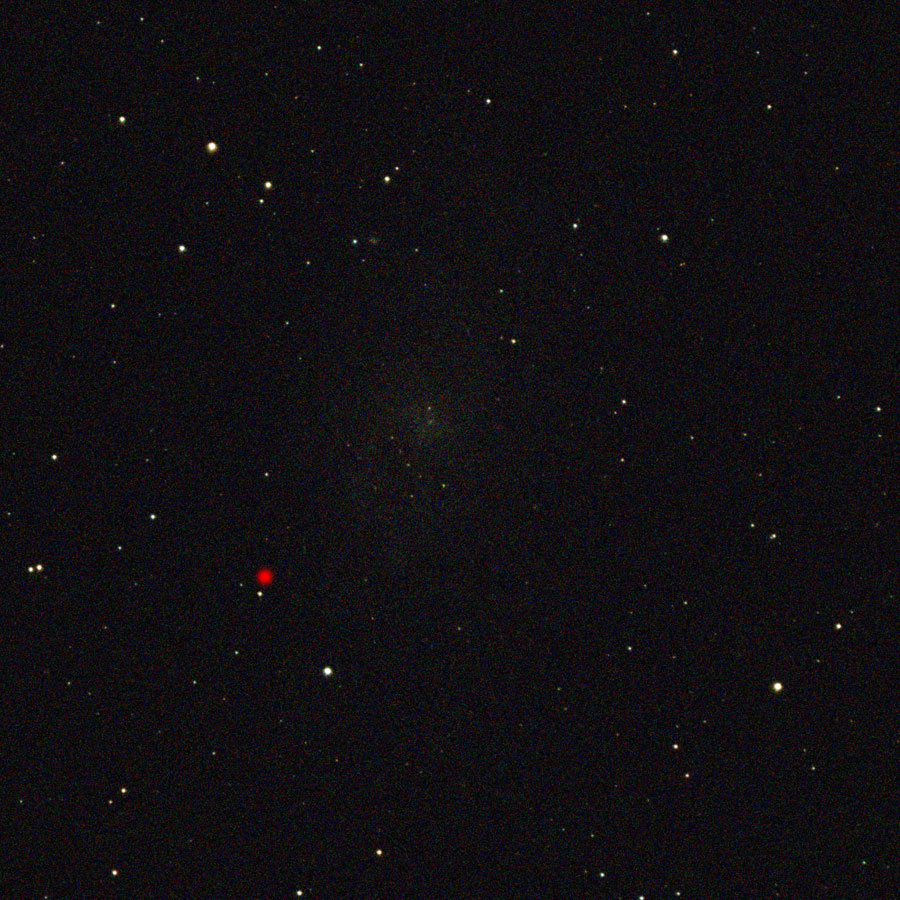
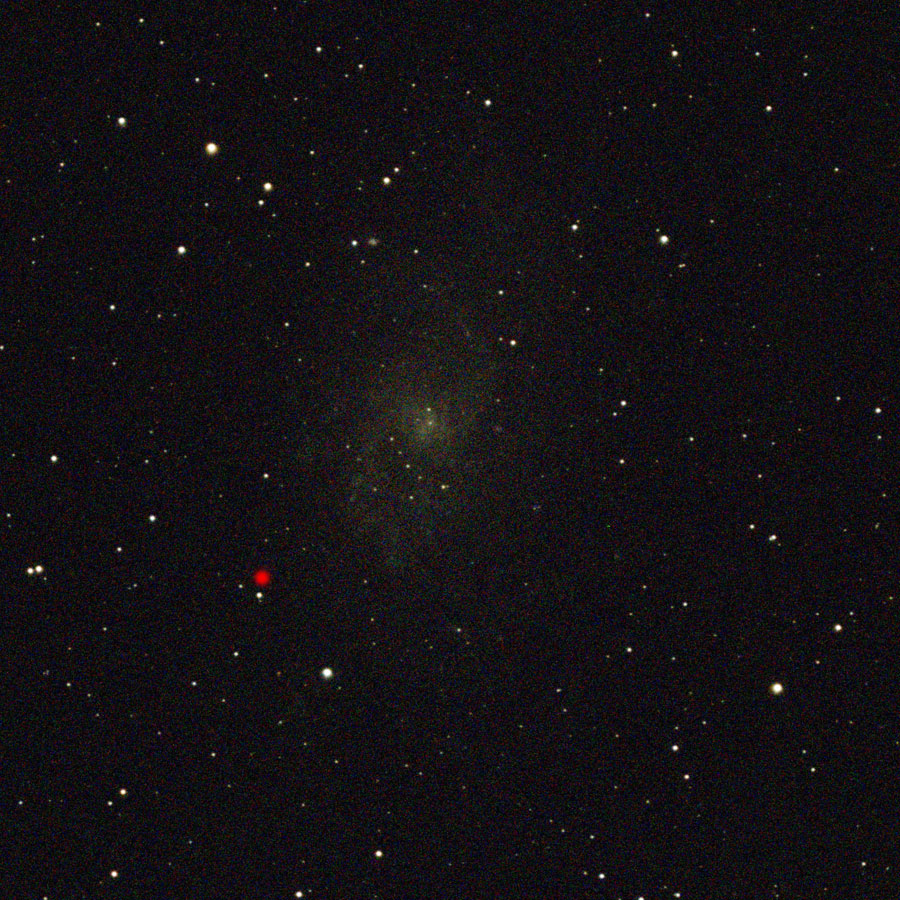
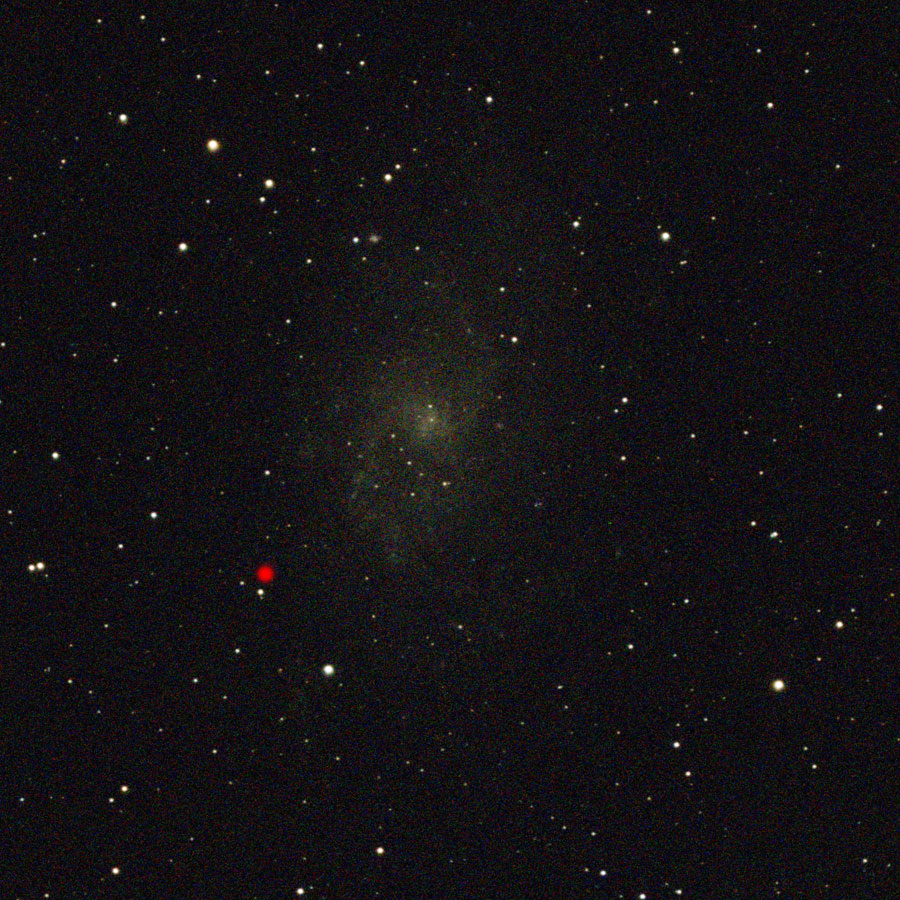
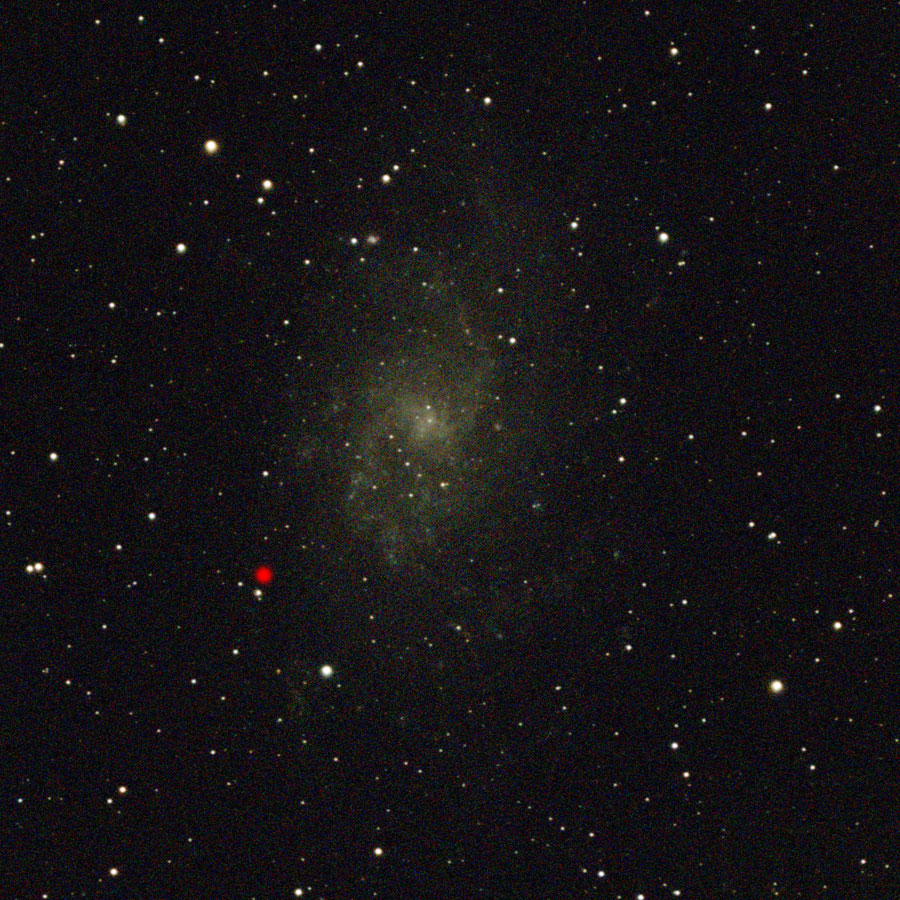
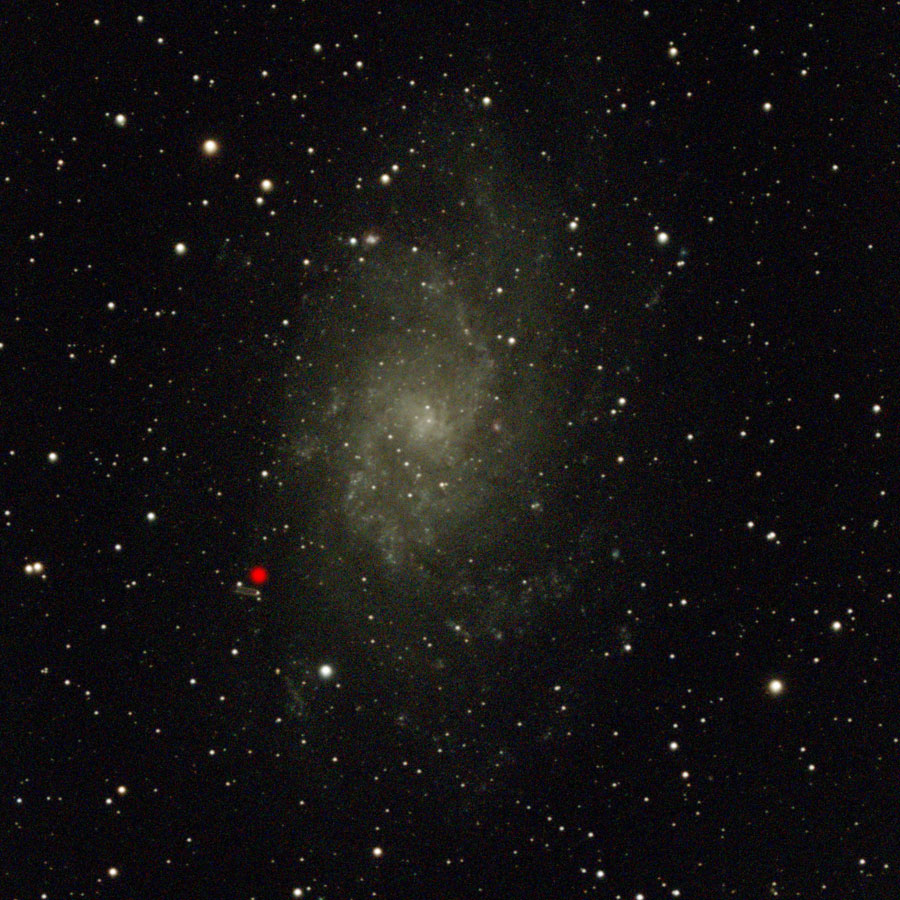
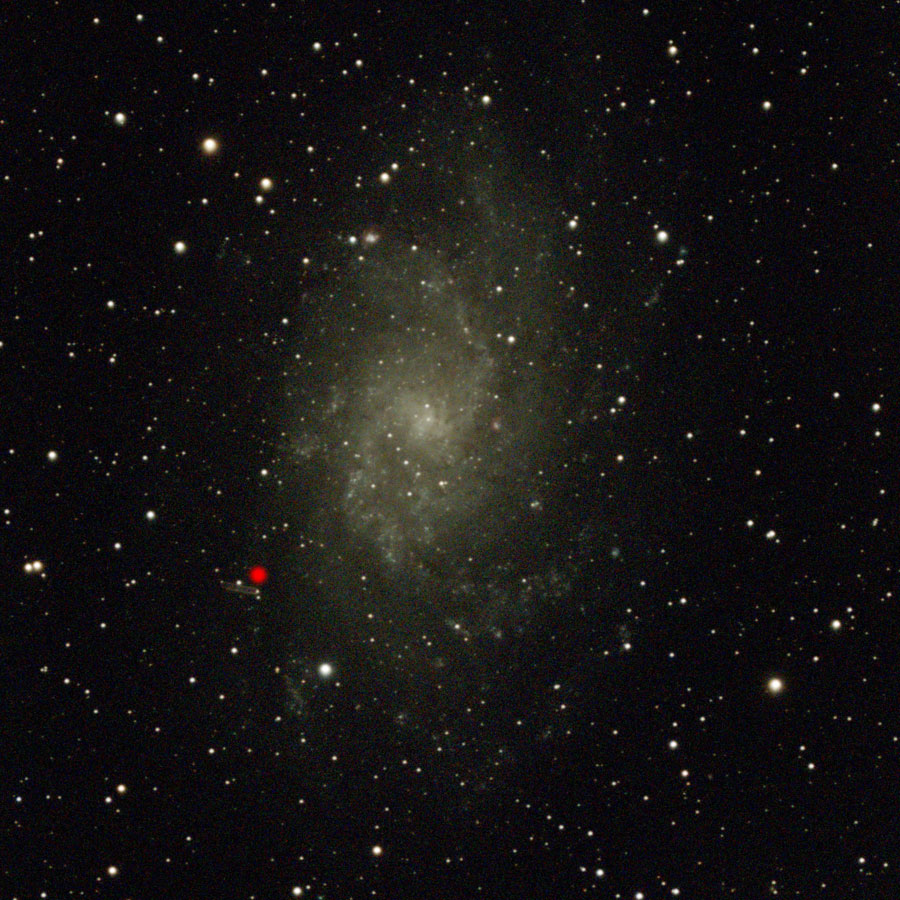
I then looked at photos with shorter integration times and found shorter trails there. Of course, the galaxy became weaker and weaker. I show some examples below! I was surprised to see that Eros was already visible "like a star" in the first photo, i.e., after 10 seconds (of course, you can hardly see anything of the galaxy)! I had actually expected Eros to be removed by the stacking algorithm over time, leaving no trace, but that was not the case. And the "initial star" also remained until the end, which surprised me a little. That is why I initially thought it was a star, but this "star" is not present in older comparable photos (see further down), which also proves that it is Eros. Incidentally, the planetary trail looks a little "double"; this is probably also due to the stacking. (see also further down)
Note: The asteroid Eros t appears in the photos as a more or less long streak because it moves differently from the stars, but the telescope tracks the stars! And the longer you observe, the longer the streak becomes, because the telescope program superimposes the images (10 seconds each) in such a way that stars and deep-sky objects (DSOs) are always aligned. However, I had expected that the so-called stacking algorithm would suppress objects that are “out of the ordinary” (such as the minor planet). Fortunately, it does not appear to do so!
After this long introduction, I would like to demonstrate the whole affair with photos!
Photos
Eros with Triangulum Galaxy M 33 - Overview
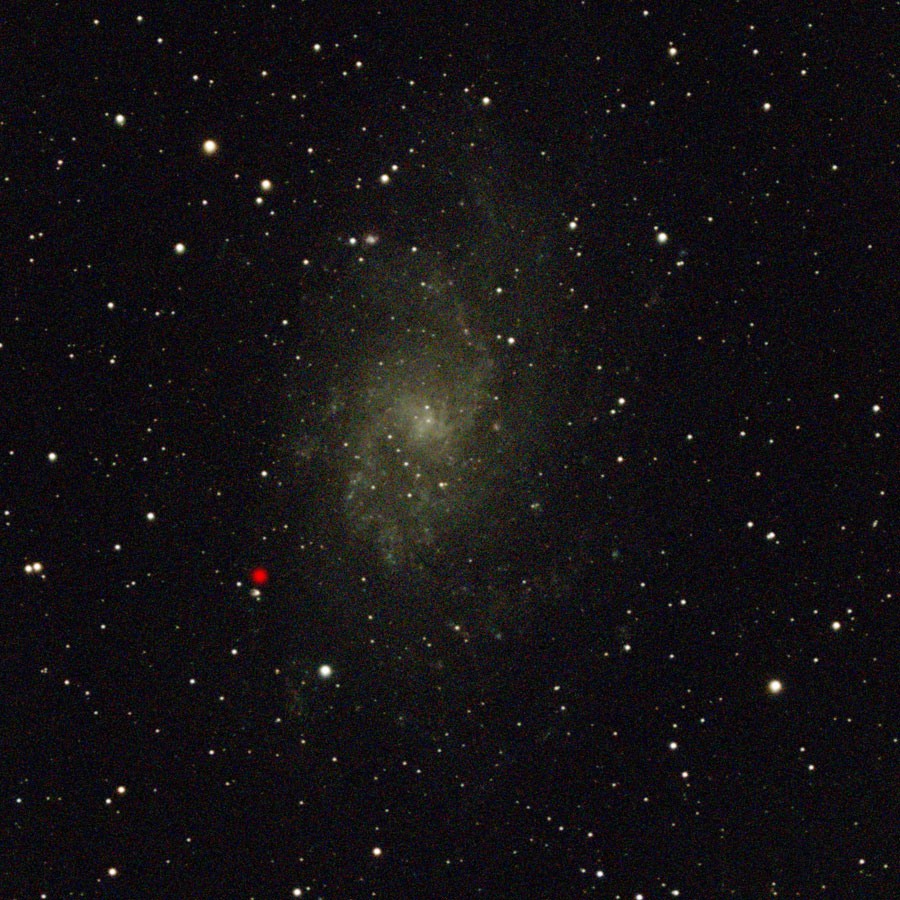
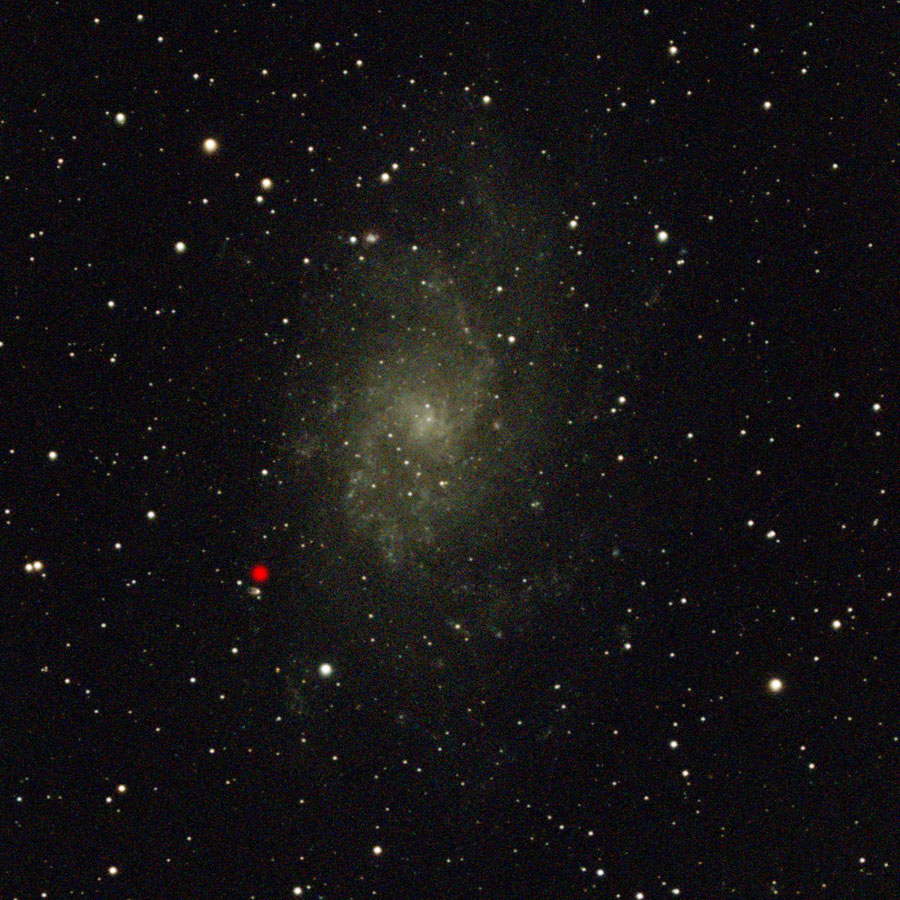
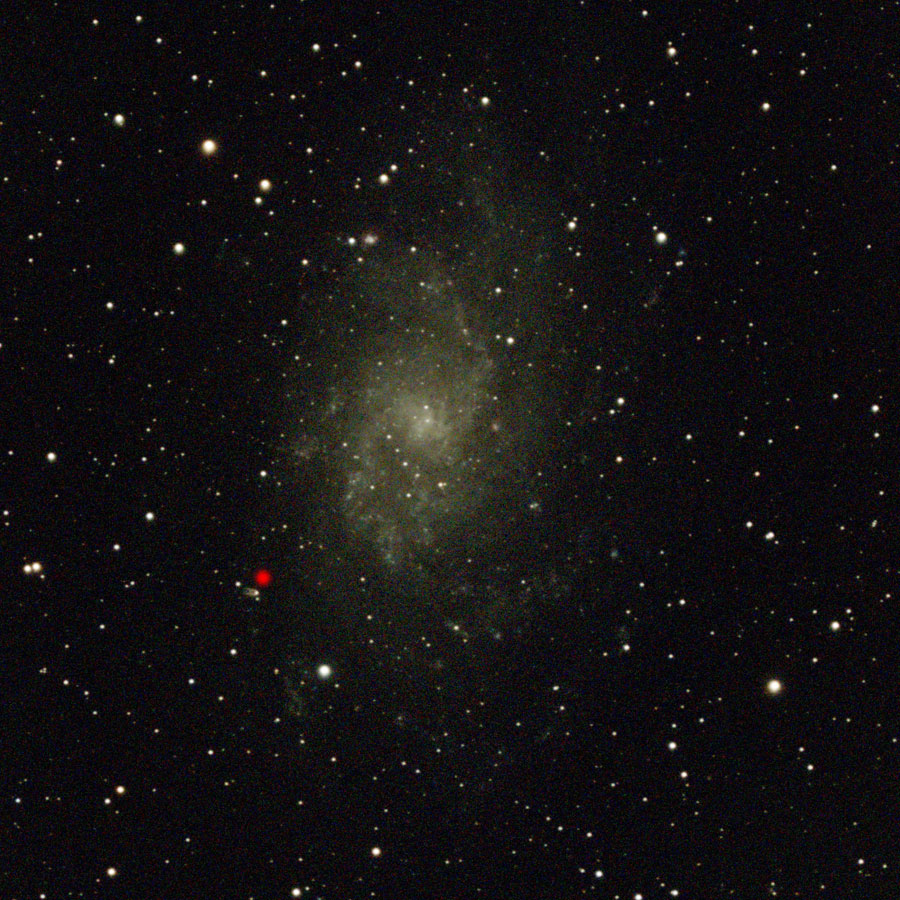
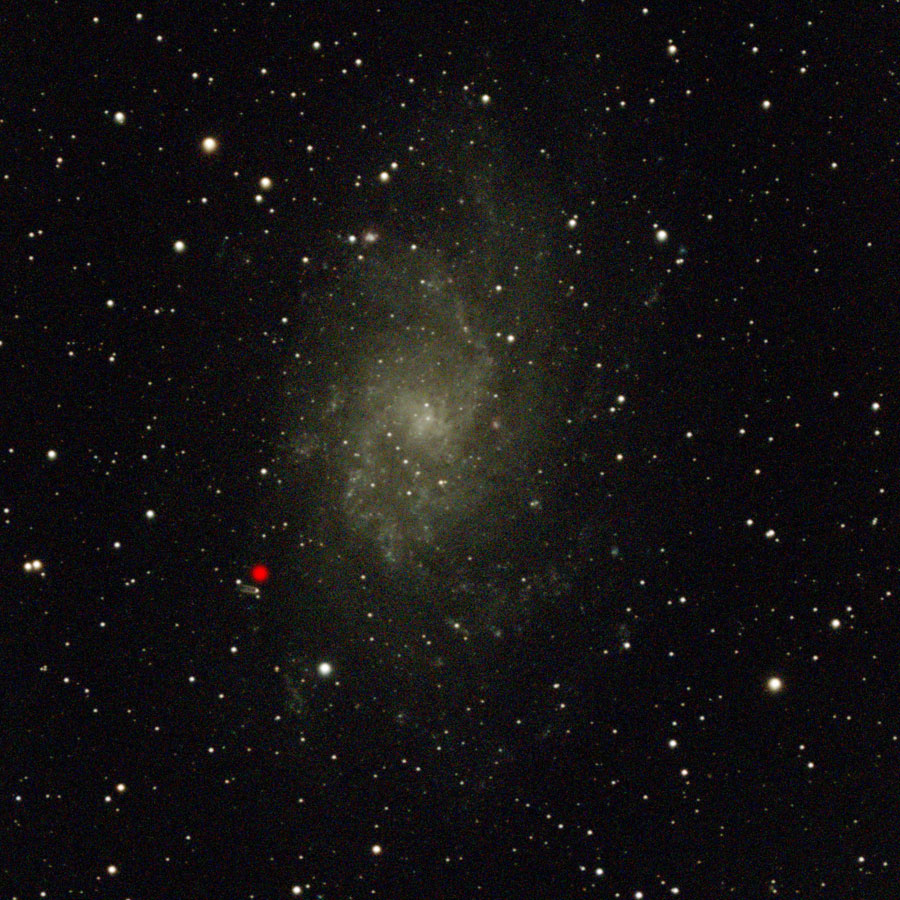
First, I will show overview photos (1:1 pixel sections at 2000 pixels) taken at different durations (integration time, not "real time"; I added the actual time to the photos)! They show, on the one hand, how the point-like minor planet Eros becomes an increasingly longer (double) streak and, on the other hand, how the triangular galaxy M 33 becomes brighter and more detailed with increasing integration time. Note that the photos are unedited! Further down, I show excerpts in which Eros is more clearly visible.
To see the trail better, please click on the photos (the image will then appear with double the side length = 900 pixels) or click on the "2000-pixel" link!
 |
 |
|
| 10s (2000 pixels) - 8:19 p.m.; Eros is already visible! | 1 min (2000 pixels) - 8:20 p.m. | |
 |
 |
|
| 1:30 min (2000 pixels) - 8:21 p.m. | 5 min (2000 pixels) - 8:25 p.m. | |
 |
 |
|
| 10 min (2000 pixels) - 8:32 p.m. | 15 min (2000 pixels) - 8:39 p.m. | |
 |
 |
|
| 20 min (2000 pixels) - 8:46 p.m. | 30 min (2000 pixels) - 8:59 p.m. | |
 |
 |
|
| 45 min (2000 pixels) - 9:18 p.m. | 60 min (2000 pixels) - 21: 9:38 p.m. |
Eros with Triangulum Galaxy M 33 - Section
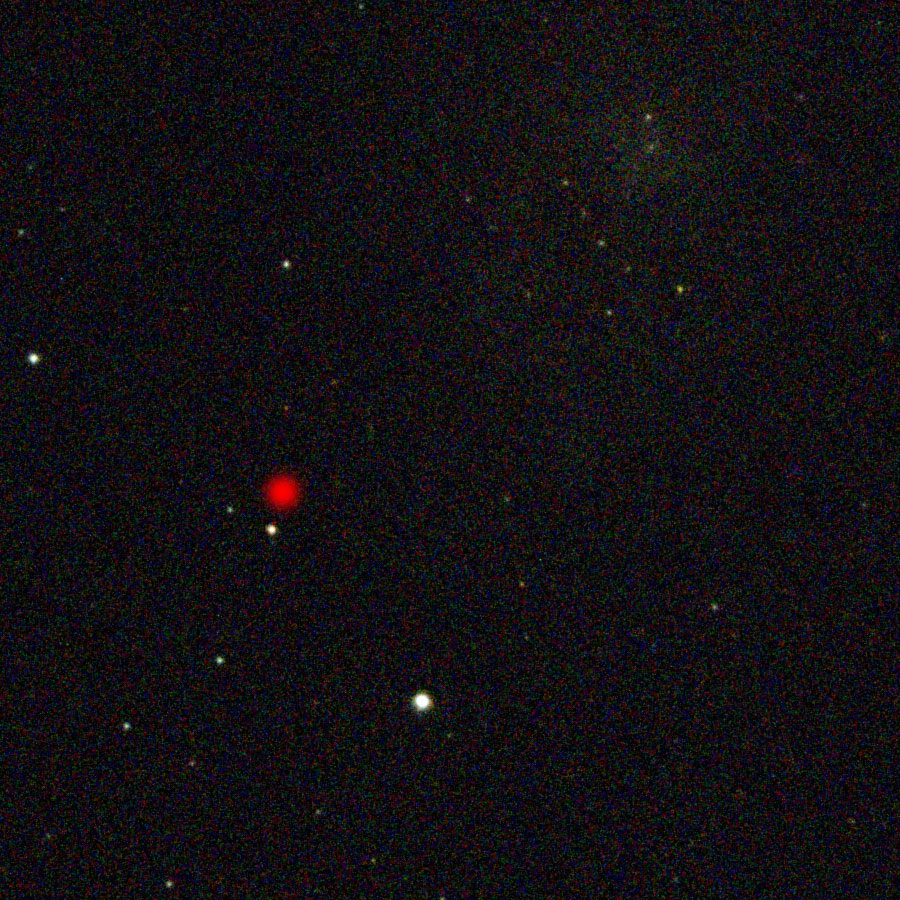
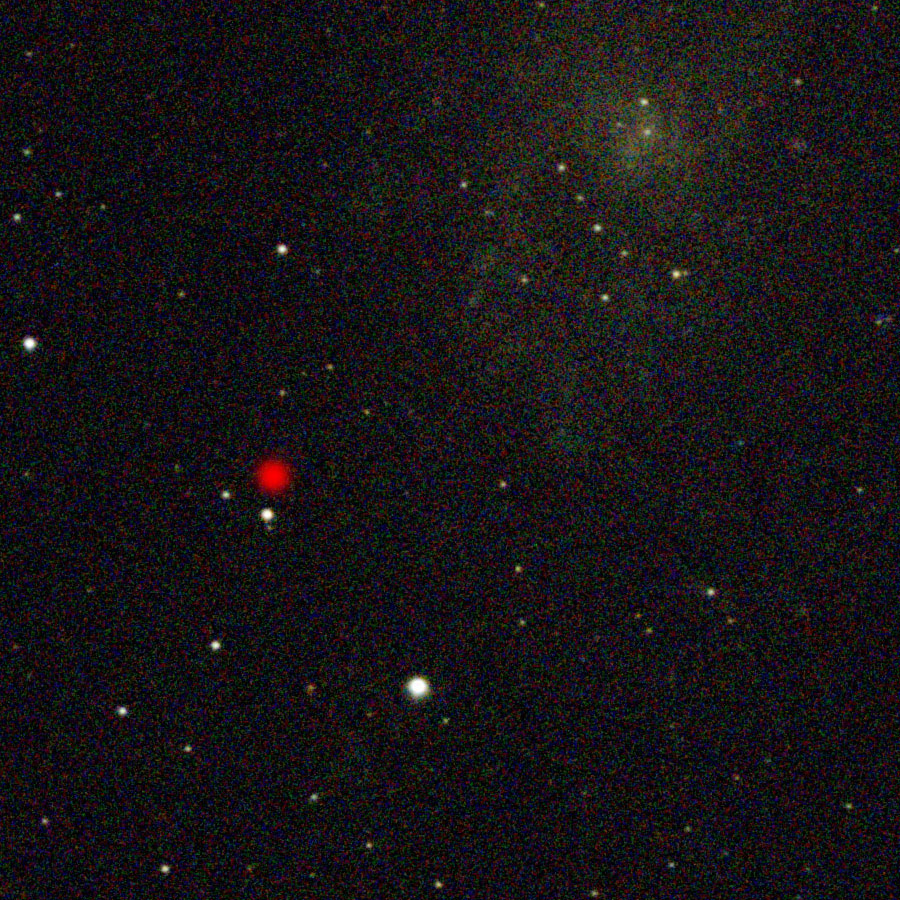
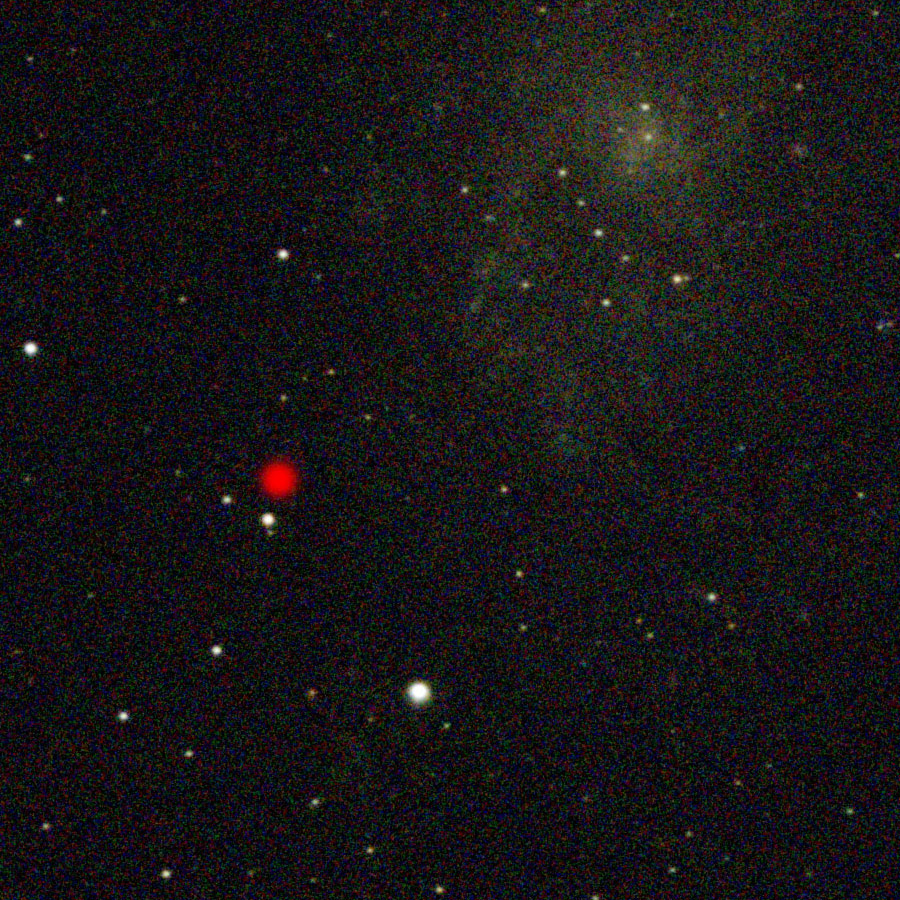
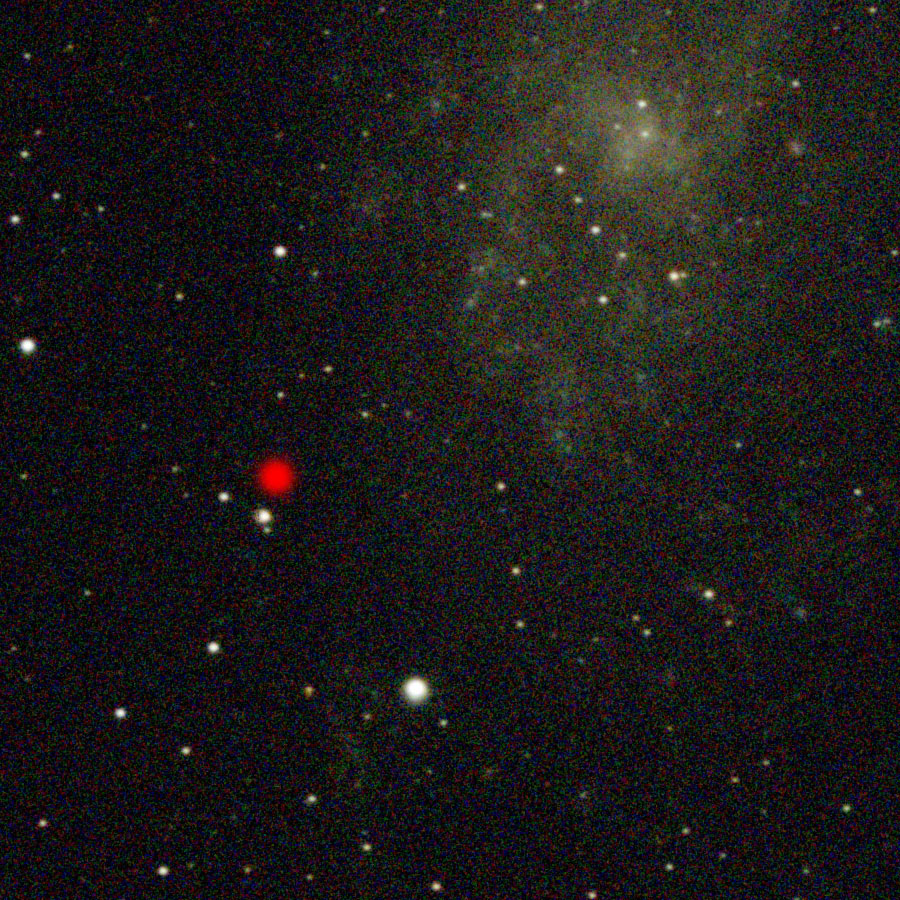
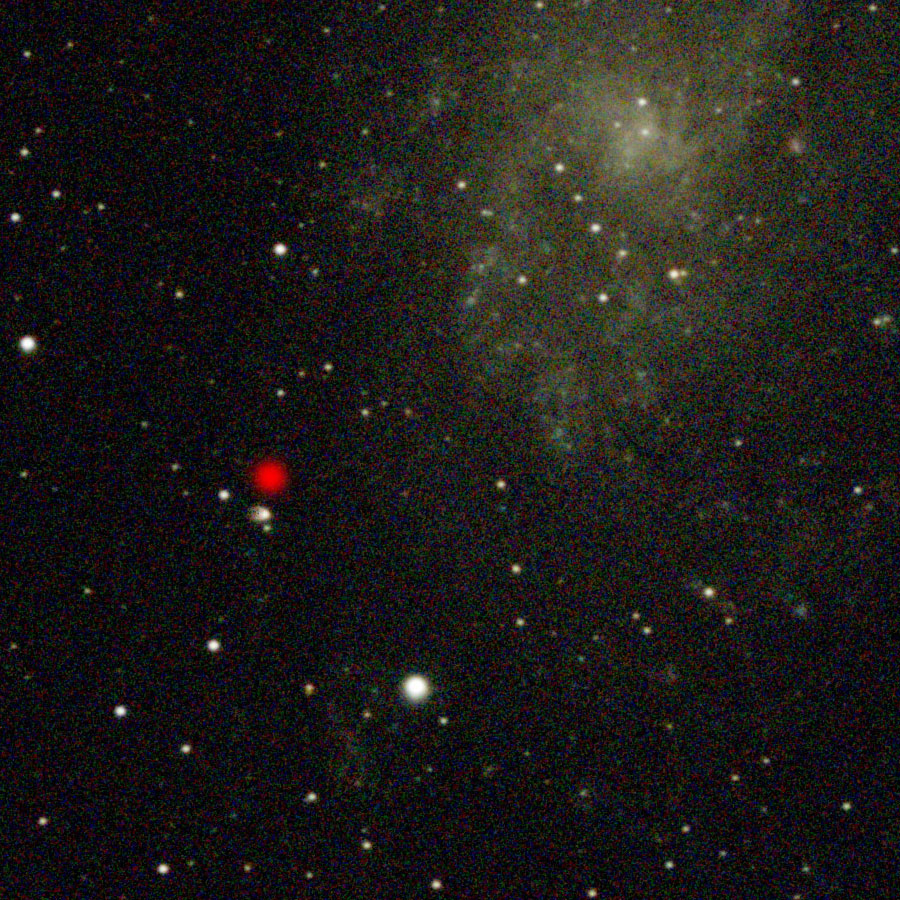
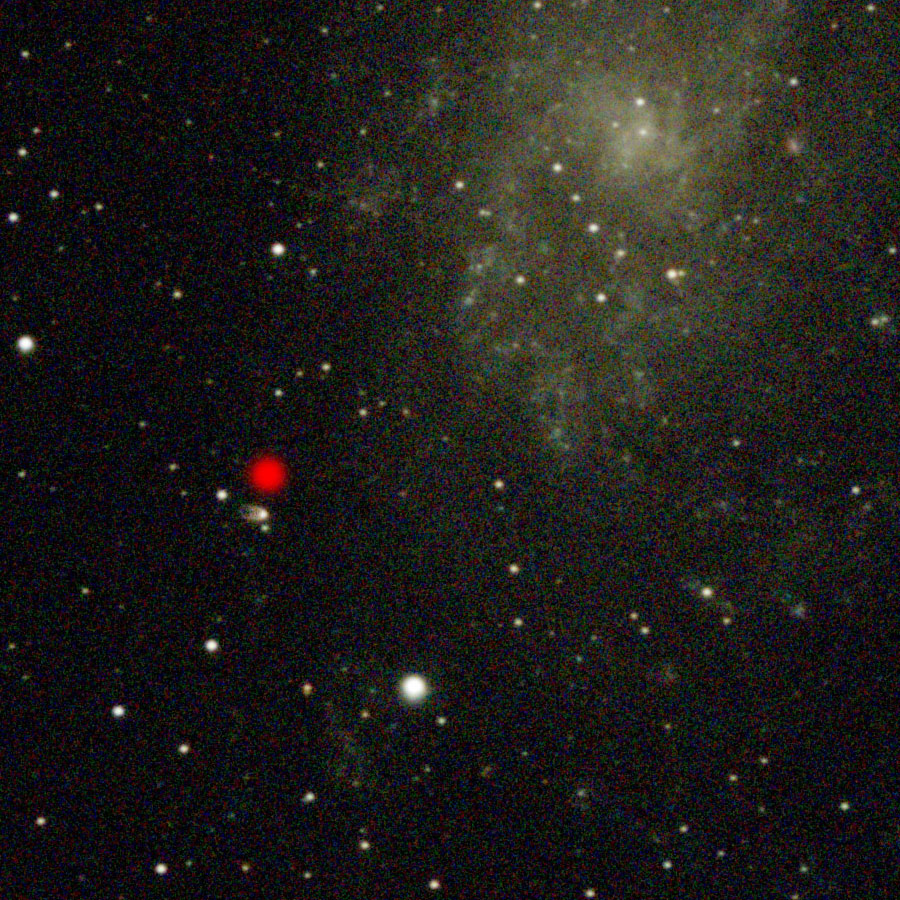
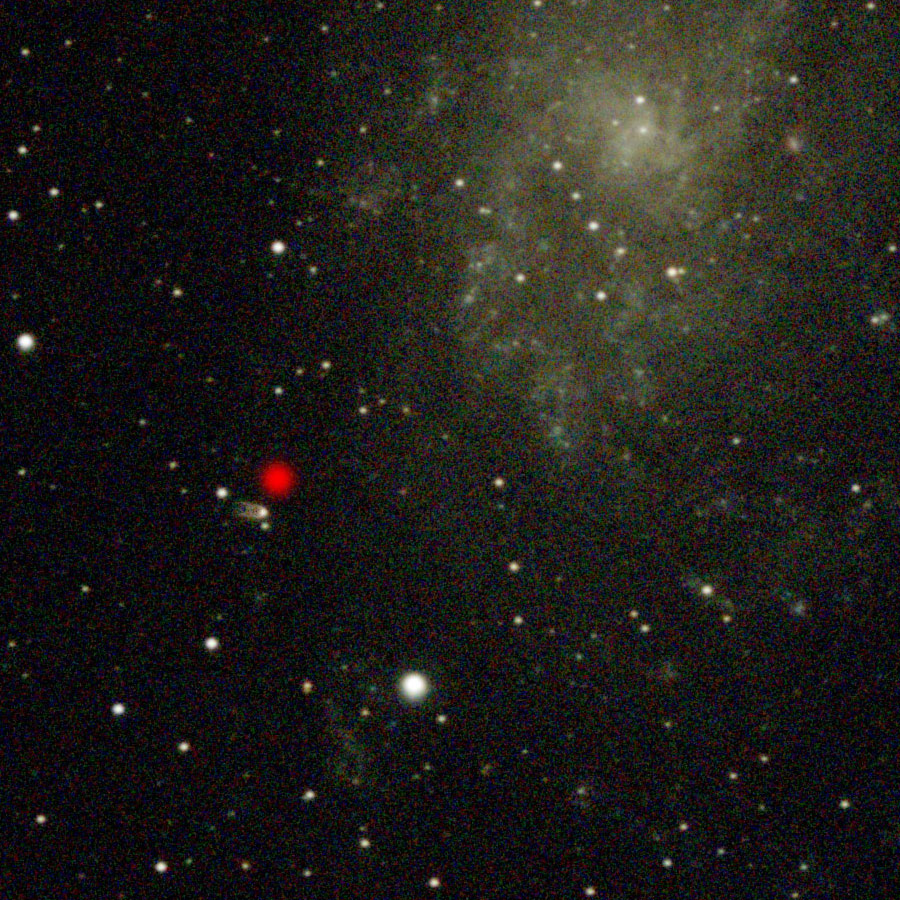
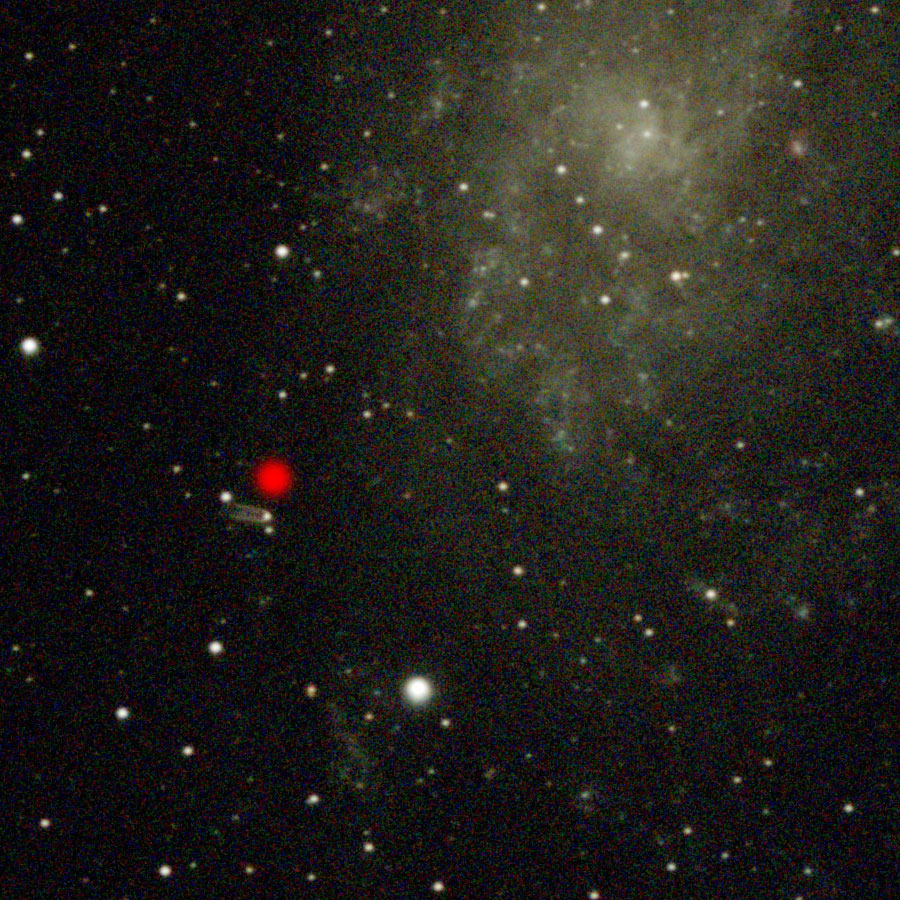
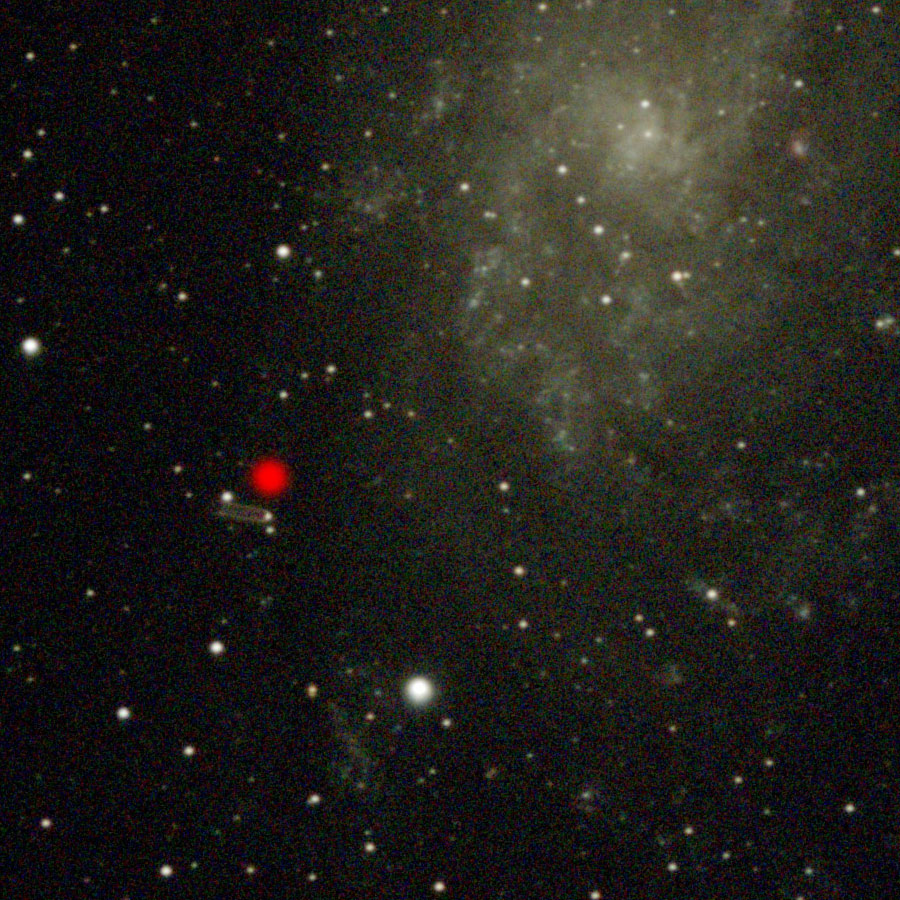
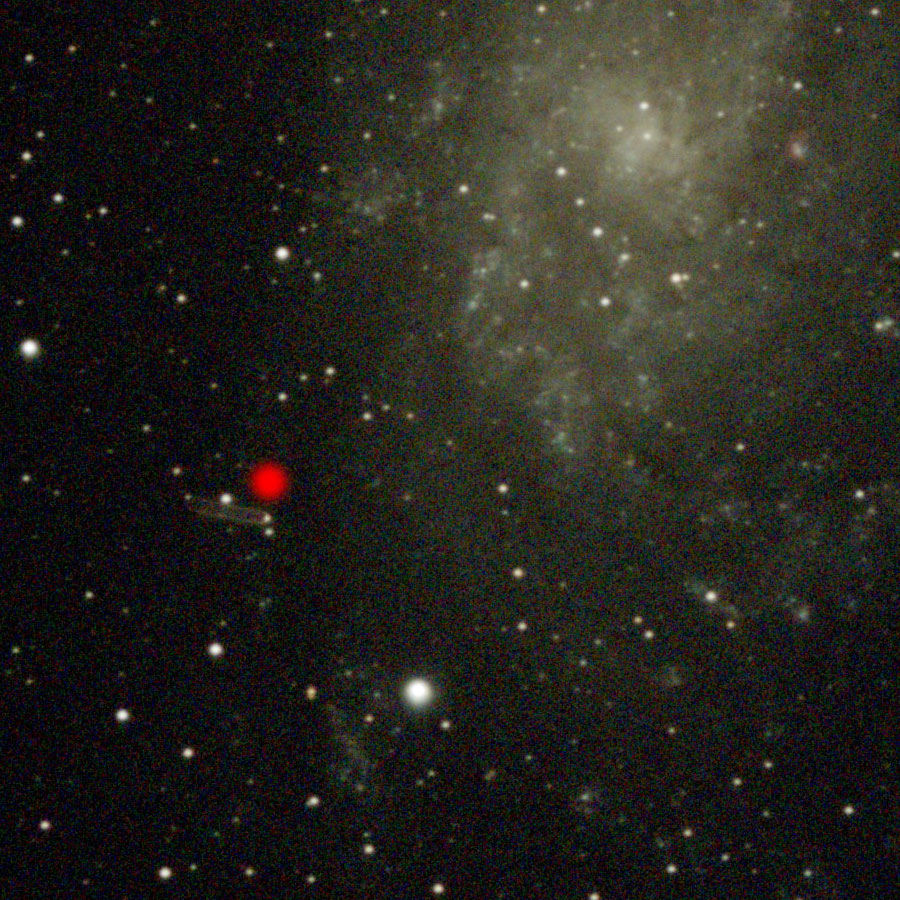
The following photos are again excerpts from the photos above (1:1 pixel excerpts at 900 pixels, click on the photos to view). After 10 seconds, i.e., already in the first image, you can see the minor planet Eros; after 5 minutes, it is no longer a point, and above it, the trail becomes longer and longer. At the same time, the triangular galaxy M 33 becomes brighter, although not as strongly after 15 minutes.
Perhaps it would have made sense to expose M 33 several times with 5-15 minutes, depending on preference, and then Eros would have been almost still a point and repeatedly imaged in different places – and M 33 would also have been relatively easy to see. Maybe next time ;)
 |
 |
 |
||
| 10s - 8:19 p.m. | 1 min - 8:20 p.m. | 1:30 min - 8:21 p.m. | ||
 |
 |
 |
||
| 5 min - 8:25 p.m. | 10 min - 8:32 p.m. | 15 min - 8:39 p.m. | ||
 |
 |
 |
||
| 20 min - 8:46 p.m. | 30 min - 8:59 p.m. | 45 min - 9:18 p.m. | ||
|
 |
|
||
| 5 min (overview) - 8:25 p.m. | 60 min - 9:48 p.m. | 60 min (overview) - 9:48 p.m. |
Trail
I photographed Eros for an hour. Since the telescope tracks the stars/DSO, but Eros moves differently, it appears as a trail. Here is a larger version of the trail:
|
||||
| 1:1 pixel section at 60 min integration time |
With an integration time (not duration) of 60 minutes, the starting point of the small planet at the beginning of the trail (i.e., on the right) is weaker than in the very first photo after 10 seconds. In addition, the trail is relatively dark and has a bright edge at the top and bottom. I wondered - and others asked me - why the trail is not simply a bright line. I also wonder why the bright spot at the beginning of the trail (on the right) remains there throughout (it becomes slightly weaker over time). I can only assume that all this is due to Vaonis' stacking algorithm. In Spektrum der Wissenschaft, I found a photo of the Eros trail (1.5 hours), which, as expected, is simply a straight bright line. Please click on the link for the photo!
Messier 33 without and with Eros
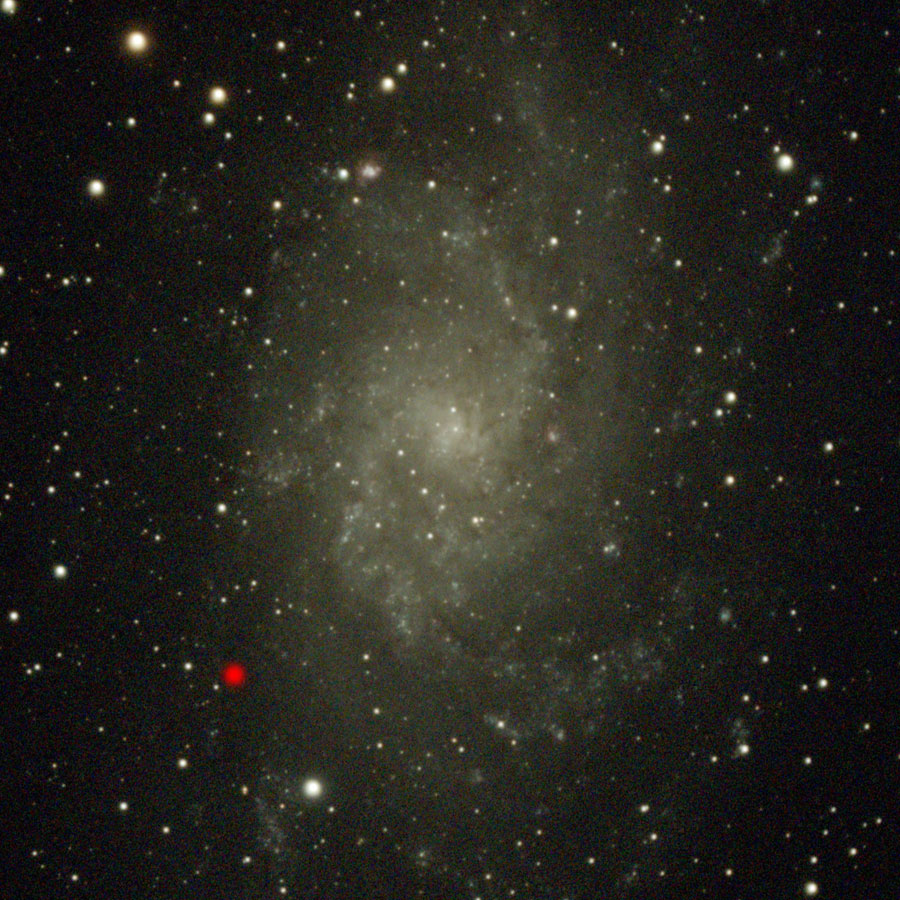
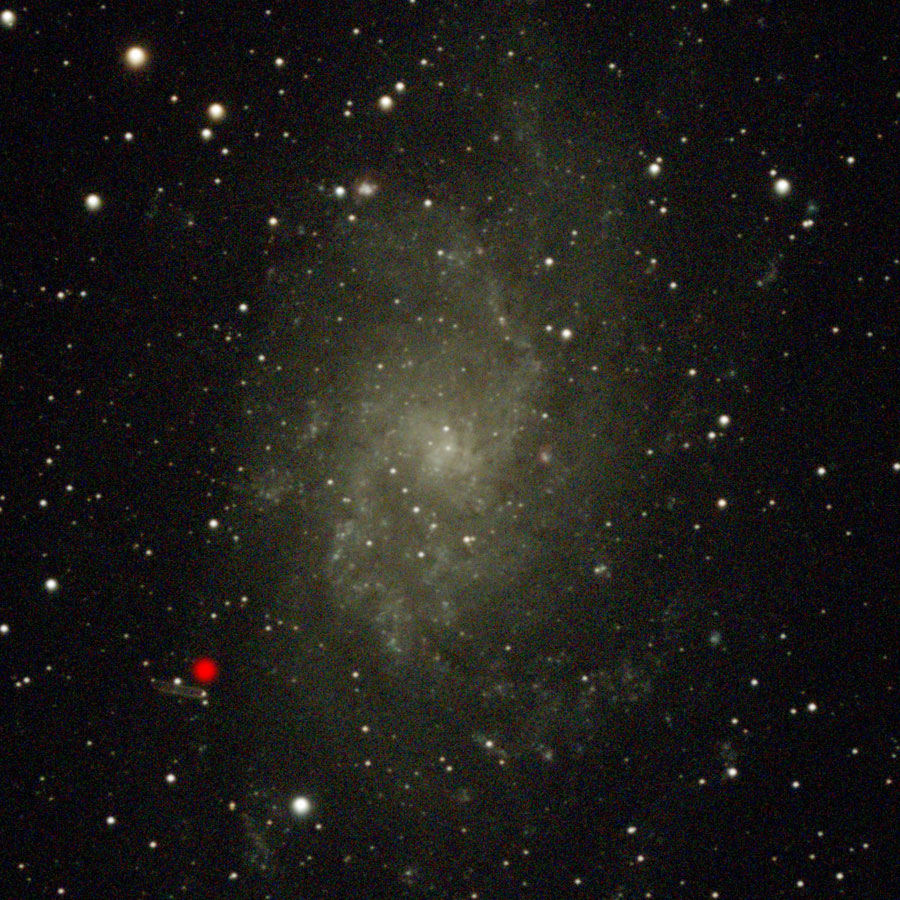
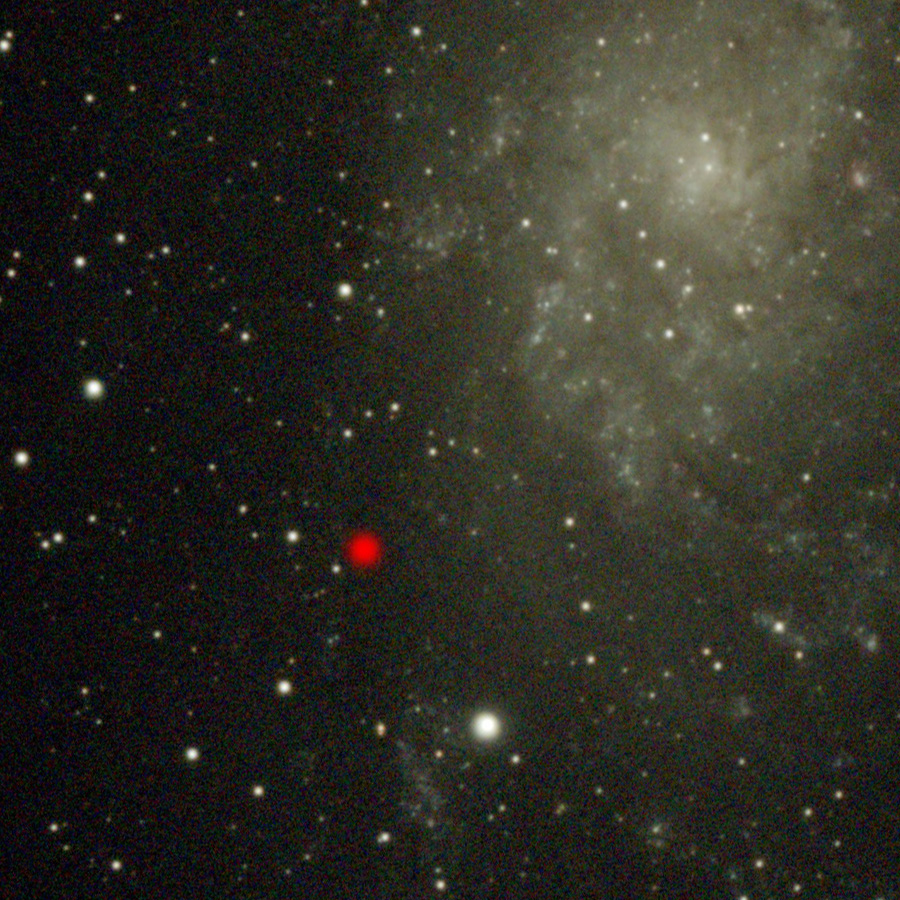
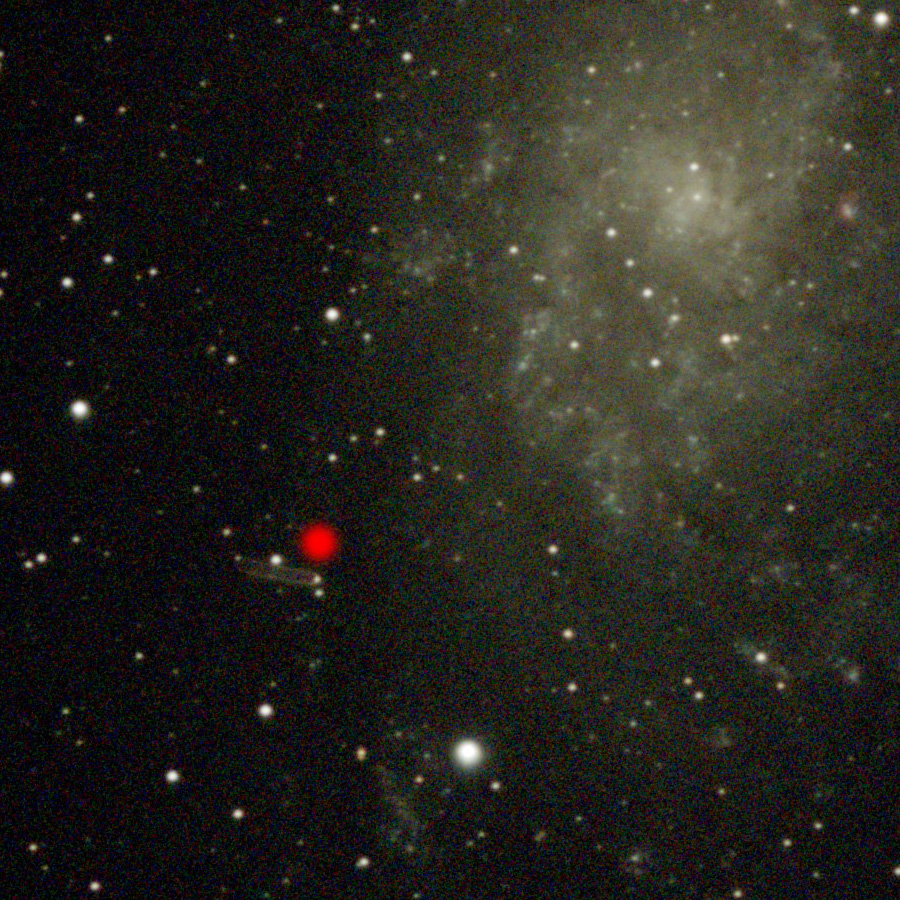
Below, I compare a photo of M 33 taken on November 21, 2025, with one taken on January 6, 2026; both were taken over a period of 60 minutes. The 1-hour photo from January 6 also shows the "star" that appears in the first photo, while the older photo does not show this "star." This is proof that Eros was indeed photographed!
 |
 |
|
| M 33 - Nov 21, 2025 (1400 pixels), 1 h, section, rotated | 60 min (1400 pixels), 9:38 p.m., section, with Eros! | |
 |
 |
|
| M 33 - Nov 21, 2025, 1 h, smaller section | 60 min - 9:38 p.m., smaller section, with Eros! |
Conclusions
Contrary to my expectations, I was actually able to photograph the minor planet Eros as it passed the Triangulum Galaxy M 33 on January 6, 2026. Unfortunately, I was a little late, especially since I was also "slowed down" at the start.
This time, I had no idea whether and how I would get Eros in the picture. But I was able to gain some useful experiences for next time. First of all, I now know that I will get Eros as a trail if I expose for longer. To make the streak clearly visible (i.e., long enough), the integration time should be at least 20-30 minutes. Then the galaxy M 33 will also be clearly visible. If, on the other hand, I would rather capture the minor planet Eros as a point of light at different positions, then the integration time should be between 5 and 10 minutes; if I want the galaxy to look better, perhaps a maximum of 15 minutes. But these are just my suggestions ;)
Links
- (433) Eros (Wikipedia): en.wikipedia.org/wiki/(433)_Eros
- Messier Catalogue - Messier 33: messier.seds.org/m/m033.html
- Messier 33 (Wikipedia): en.wikipedia.org/wiki/Messier_33
- (433) Eros bei M33 (Wolfgang Bodenmüller & Hans-Hellmuth Kuno; Spektrum der Wissenschaft): www.spektrum.de/alias/wunder-des-weltalls/433-eros-bei-m33/2304480 (in German)
- Asteroid Eros begegnete Dreiecksgalaxie (Schulsternwarte und Volkssternwarte Crimmitschau): sternwarte-crimmitschau.de/start.php?aid=341 (in German)
Appendix
(433) Eros
(433) Eros is a stony asteroid of the Amor group, and the first discovered, and second-largest near-Earth object. It has an elongated shape and a volume-equivalent diameter of approximately 16.8 kilometers (10.4 miles). Visited by the NEAR Shoemaker space probe in 1998, it became the first asteroid ever studied from its own orbit.
The asteroid was discovered by German astronomer C. G. Witt at the Berlin Urania Observatory on 13 August 1898 in an eccentric orbit between Mars and Earth (having a magnitude of 11).
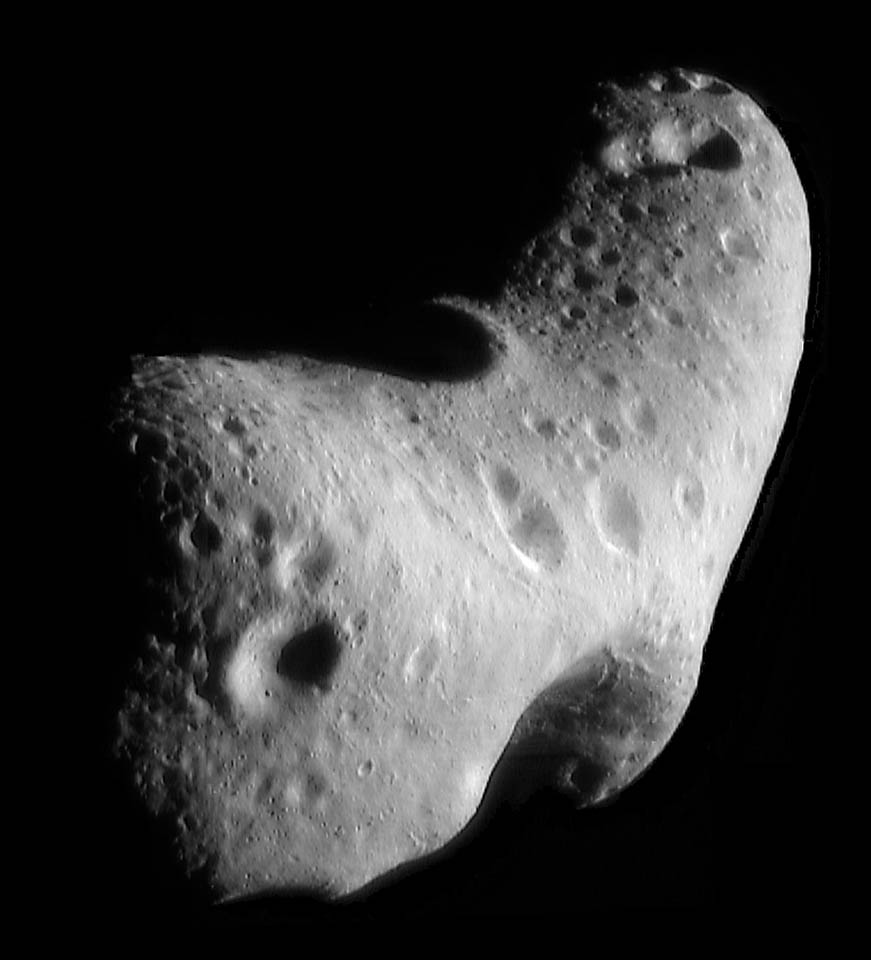
Foto: View of (433) Eros with the craters Narcissus (in front), Psyche (on top), and Himeros (bottom) (Wikipedia)
See also (433) Eros (Wikipedia): de.wikipedia.org/wiki/(433)_Eros
Triangulum Galaxy M 33
The Triangulum Galaxy M 33 in constellation Triangulum is the third largest galaxy in the "local group," which also contains our Milky Way and the Andromeda Galaxy M 31. It is considered to be the most distant celestial object visible to the naked eye. I had problems even with my small refractor to catch just a glow at all. When using smart telescopes, M 33 is easy to observe.
| M 33 (NGC 598) | NGC 604 (H II Region) | |
| Size: 30' x 20' / 70.8 x 41.7(Stoyan/Wikipedia) Distance: 2.76 million light years (Wikipedia) Rating: *** (Stoyan) |
Size: 2' (Wikipedia) Distance: 2.76 million light years (Wikipedia) Rating: --- |
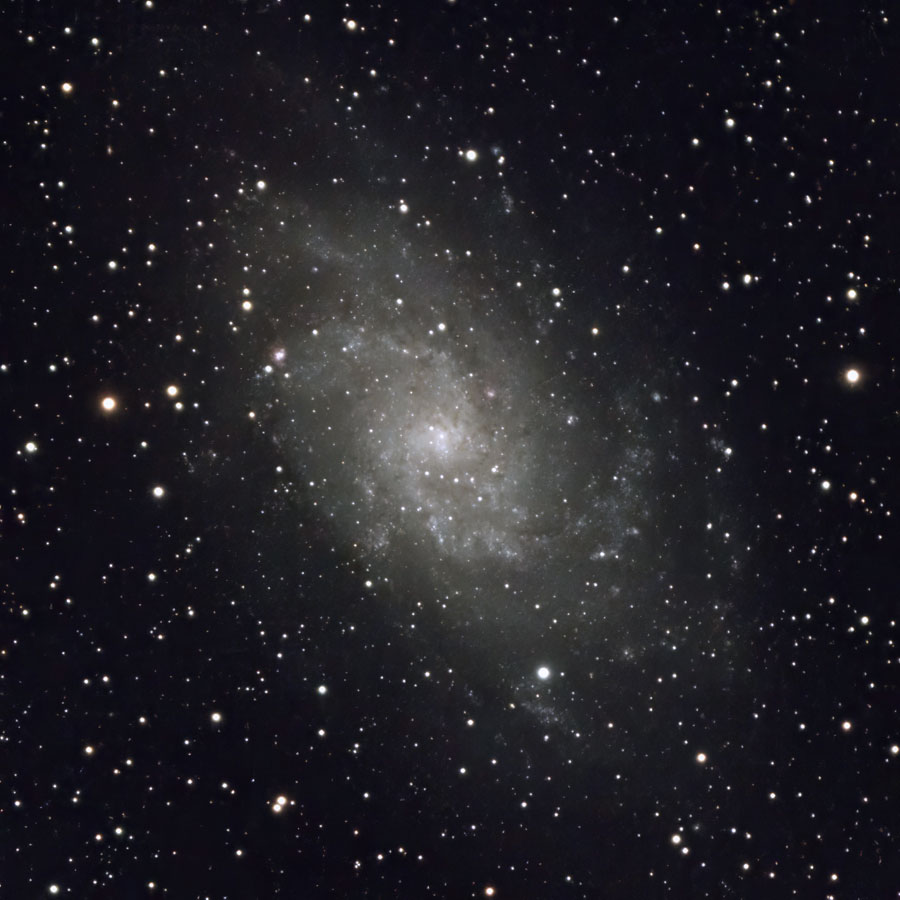
See also my page on the Triangulum Galaxy and en.wikipedia.org/wiki/Messier_33 on Wikipedia!
|
made by  on a mac! on a mac! |


| 13.01.2026 |  |