

Astronomy | GXR · GR · RX100 M1 · RX100 M4 · RX10 M3/4 · TZ202 · X Vario · M240 · General | Photos | Conf. Places | Calendars | Art
Ricoh GXR: Me and the M-Mount
Preparations for the Unit | The Unit Arrives | Resolving the Issue | Expanding the Equipment | Preliminary Conclusions | Links
Archive
After Ricoh's official announcement of the M-mount expansion unit, I decided to buy one, although I had not intended to do so originally. This section on the site is devoted to my experiences with the expansion unit and the lenses that I bought (or tried to buy).
Note: For general information about the A12 M-Mount expansion unit see here.
Preparations for the Unit
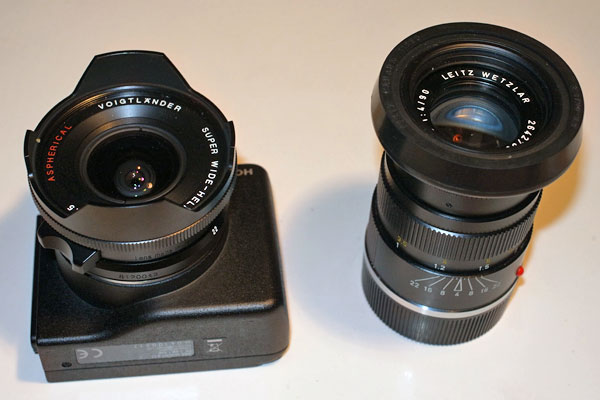
In preparation for the M-mount expansion unit, I also bought one lens and auctioned another on. Both were meant to extend the range of my two A12 units: one at the wide end and one at the tele end. Firstly, I bought a Voigtländer Super Wide Heliar 15mm f/4.5 for about 500 EUR, which is manufactured by Cosina and equivalent to a 22.5 mm wide angle lens, thus very close to a full-format 24 mm lens. Secondly, I auctioned a Leitz Elmar-C 90mm f/4, which was originally dedicated to the Leica CL and at the GXR corresponds to a 135 mm tele lens. The Leica CL was manufactured for Leitz by Minolta in the 1980s. Minolta also sold an own version of this camera, even after Leitz had discontinued it. I read that the Minoltas version of the Elmar was the only Japanese lens that was manufactured in Germany...
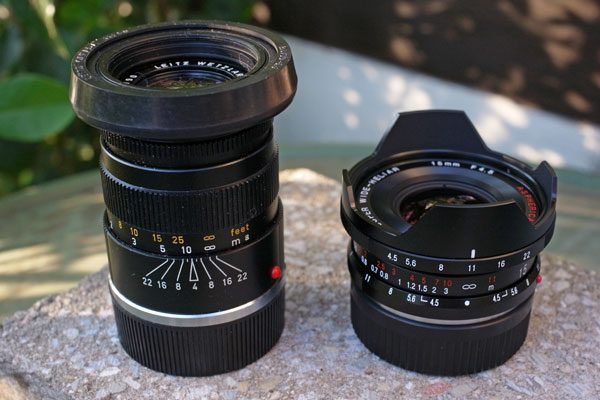
Photo: The Elmar-C (left) and the Voigtländer (right) lenses
 |
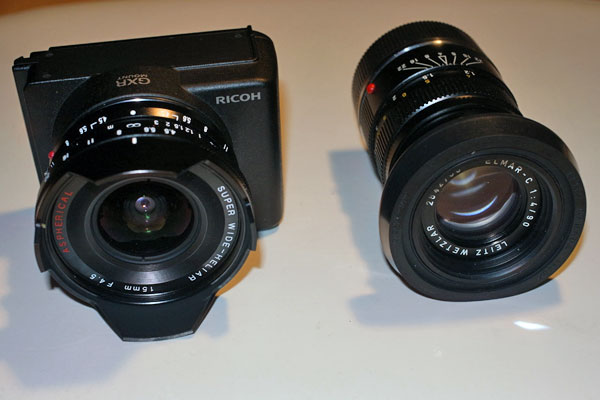 |
Photos: The Voigtländer (left) and the Elmar-C (right) lenses
The Unit Arrives
Foto Koch in Germany offered the unit for pre-order in August 2011 (or even earlier), but I decided to wait until my summer holiday had ended at the end of September. Then, however, the first wave of units had already been sold, and no more units were available in Germany thereafter (and Foto Koch had also raised the price). There was another shop in Germany that offered the unit, but there it was also not immediately available. However, when I looked at their site again on October 12, the unit was - unexpectedly - available, and I managed to order and get one (it looked to me as if they had only three units...). My excitement lasted, however, for only about 15 minutes. Then the plastic knob, which has to be pressed for exchanging lenses, fell off. One screw remained behind a metal lever and the second was gone forever - I assume it was never there...
 |
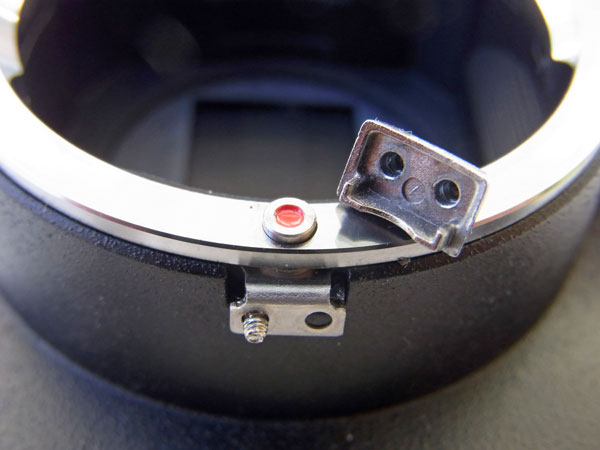 |
Photos: After about a quarter of an hour, the plastic knob fell off - probably it had never been fixed properly...
Nevertheless, I was still able to exchange lenses by pushing the metal lever and, thus was able to make a few test shots - and the results that my two new lenses produced were very pleasing.
Resolving the Issue
I was very frustrated by this experience and addressed my Ricoh contact, Mr. Wutzke, once again. This time, he even offered to discuss the issue with me on the phone - what we did after the weekend. In parallel, I also contacted the dealer who offered to exchange the lens. I did not expect this to be a viable option because of the few samples that were available, but obviously the units were now arriving in in larger quantities... Therefore, we all agreed to have the unit exchanged by the dealer. Both the dealer and me sent the units on Tuesday, and both of us received them on Wednesday. Thus, a week after my order I finally had a functioning unit in my hands...
Expanding the Equipment
Shortly after acquiring the M-mount expansion unit and two lenses, I changed my mind and considered expanding the range of my M-mount lenses so that I could use the unit "stand-alone." In October and November, 2011, I therefore bought three lenses for the M-mount unit, eventually all of them being Zeiss lenses after having some trouble with two decentered Voigtländer lenses.
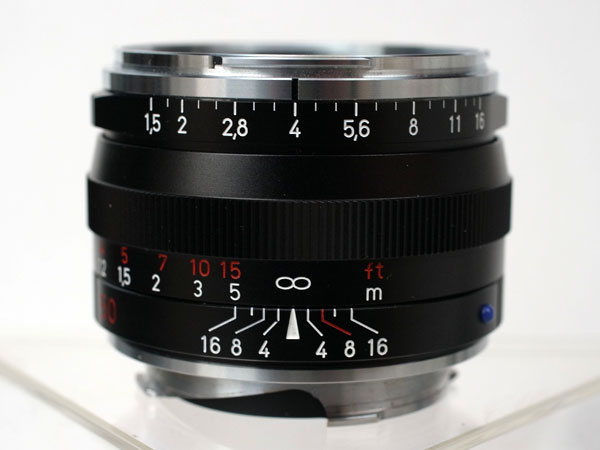
First, at the end of October, 2011, I bought a Zeiss Sonnar T* C 1:1,5/50 mm ZM (black) (75 mm equiv.), my most expensive and fastest lens up to then:
 |
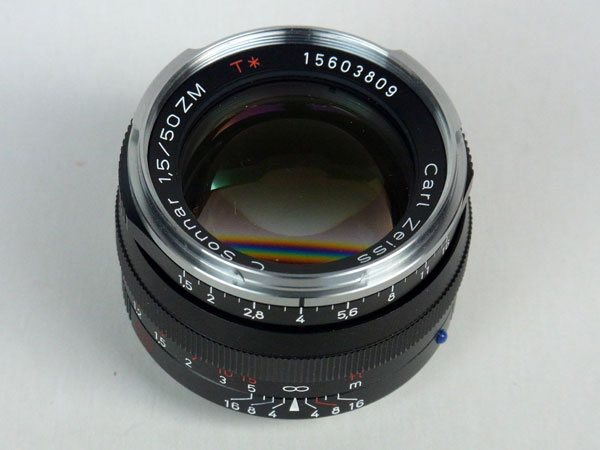 |
Photos: Arrived on October 25, 2011: Zeiss Sonnar T* C 50mm f/1.5 ZM (black) (75 mm equiv.)
Side-Step: My (Temporary) Voigtländer Skopar Pancakes
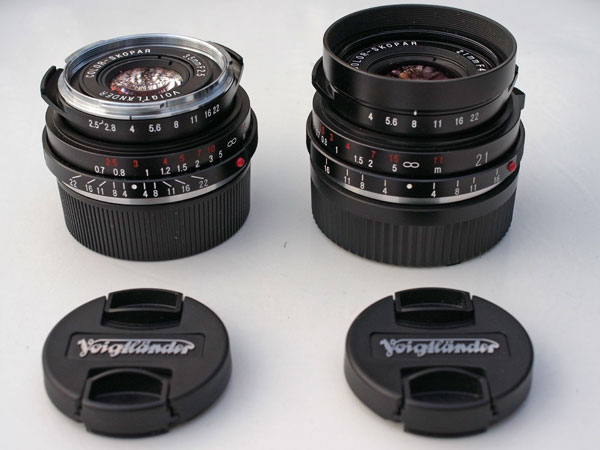
Then, I bought two Voigtländer pancake lenses, a 35 mm and a 21 mm one. Regrettably, both were decentered - I tested even two samples of the 35 mm version - so that I returned them and replaced them with two Zeiss Biogon lenses, the 35mm f/2.8 and the 21mm f/4.5 Biogon.
 |
 |
|
| Photo: Arrived on November 8/17, 2011: Voigtländer Color Skopar Pancake II 1:2.5/35 mm (52.5 mm equiv.) -> returned (Nov 14 and Nov 21) | Photo: Arrived on November 16, 2011: Voigtländer Color Skopar Pancake II 1:4/21 mm (31.5 mm equiv.) -> returned (Nov 21) |
Here are the details on the Voigtländer lenses: The first sample of the Voigtländer Color Skopar Pancake II 35mm f/2.5 was fuzzy at the right edge. I exchanged it for another one that was fuzzy at the left edge, particularly at the lower left corner. Therefore, I decided to return it as well and bought a Zeiss Biogon 35mm f/2.8. The first sample Voigtländer Color Skopar Pancake II 21mm f/4 was fuzzy at the left edge, for a change. I returned it as well and bought a Zeiss Biogon 21mm f/4.5 from the same dealer. In the end, this lens was even a little bit more expensive than my Zeiss Sonnar.
 |
 |
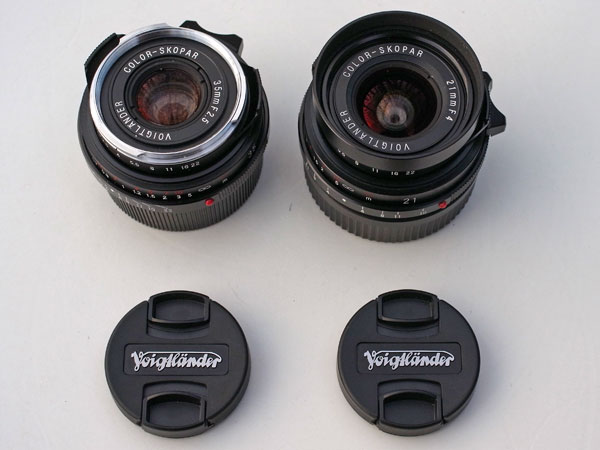 |
Photos: Voigtländer Color Skopar Pancake II 35mm f/2.5 (left) and Voigtländer Color Skopar Pancake II 21mm f/4/21 mm (right) - click photos for larger versions
All in all, I was less than satisfied with the two Voigtländer Color Skopar Pancake II lenses that I bought. While these lenses got some favorable reviews, you probably need to be very lucky when you take part in the Voigtländer lens lottery. A dealer who should know better (they have 80% of the Voigtländer market) told me that only 0.4% of the Voigtländer are returned, which is as low as the return rate for Zeiss and Leitz lenses - regrettably mine was 75%! Obviously, I was not lucky. Therefore, with a heavy heart I decided to go for the much more expensive and bulky Zeiss Biogon lenses.
Two More Zeiss Lenses
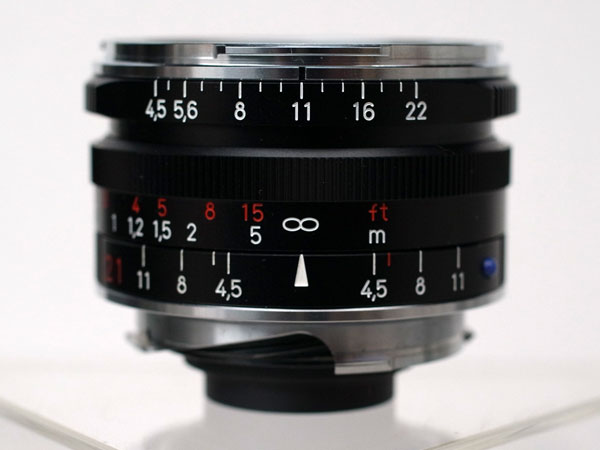
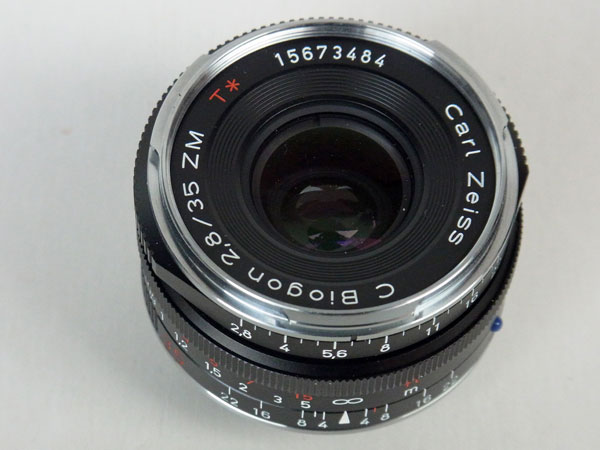
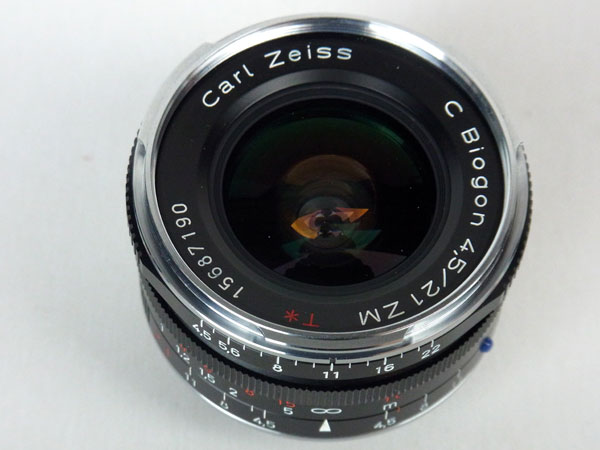
So here are my two Zeiss Biogons, a Zeiss Biogon 35mm f/2.8, and a Zeiss Biogon 21mm f/4.5/2 that eventually replaced the Voigtländer pancake lenses:
 |
 |
|
 |
 |
|
| Photos: Arrived on November 22, 2011 as a replacement: Zeiss Biogon T* C 35mm f/2.8 ZM lens (black) (52.5 mm equiv.) | Photos: Arrived on November 32, 2011 as a replacement: Zeiss Biogon T* C 21mm f/4.5 ZM lens (black) (31.5 mm equiv.) |
The Zeiss lenses are a little bit slower, heavier, and much more expensive than the respective Voigtländer pancakes.
Further Additions
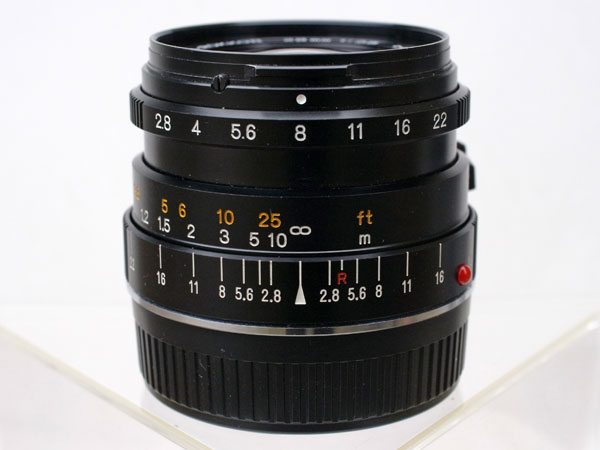
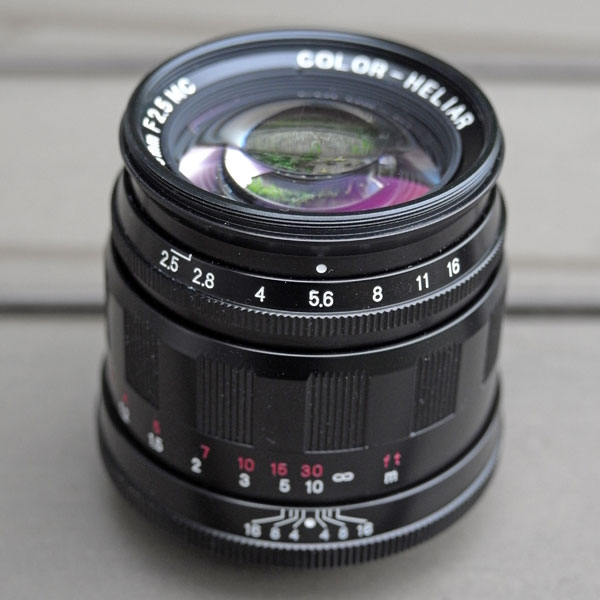
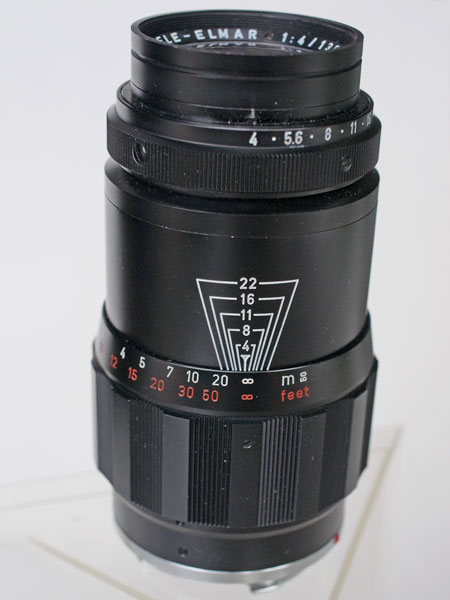
From 2012 to 2014, I added four more lenses to my M-mount lens collection (including two M39 screw-mount lenses, each with a dedicated LTM adapter): Voigtländer Snapshot-Skopar 25mm f/4 (M39), Minolta Rokkor 28mm f/2.8, Voigtländer 75mn f/2.5 (M39), and Leitz Tele-Elmar 135mm f/4. See the photos below:
 |
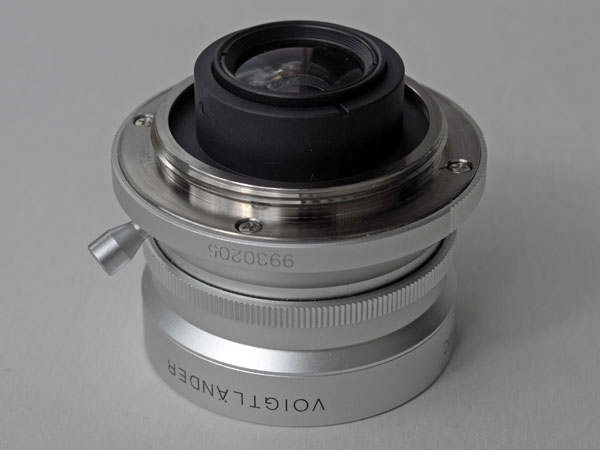 |
Photos: Voigtländer Snapshot-Skopar 25mm f/4 Pancake (37.5 mm equiv.) (mid-June 2014)
 |
 |
Photos: Arrived on April 4, 2013, a Minolta M-Rokkor 28mm f/2.8 lens (42 mm equiv.)
 |
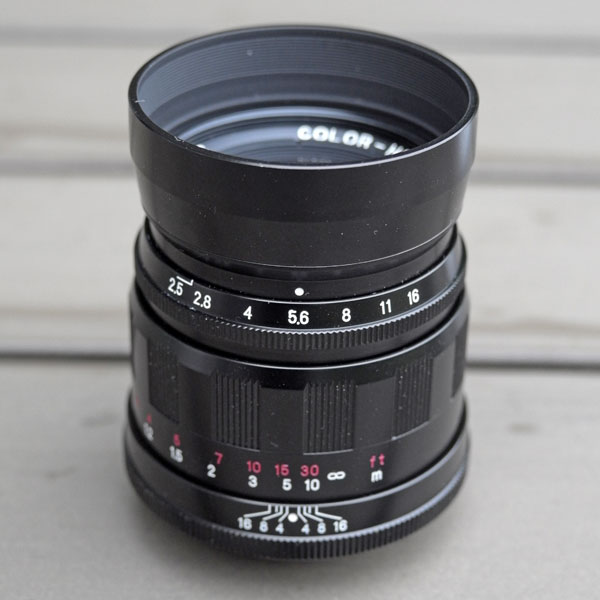 |
Photos: Arrived on June 4, 2014, a Voigtländer Color Heliar 75mm f/2.5 lens (112.5 mm equiv.)
 |
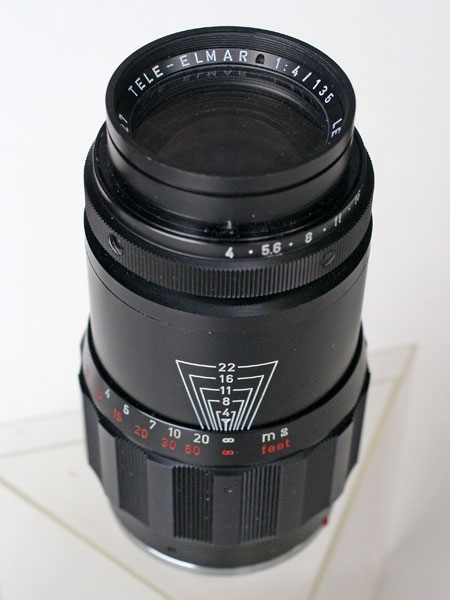 |
Photos: Leitz Tele-Elmar 135mm f/4 lens (200 mm equiv.) set to infinity (bought in 2012)
See page My Equipment Related to the M-mount Expansion Unit for an overview of my M-mount related equipment. See the links below for information in the individual lenses and the M-Mount expansion unit.
Preliminary Conclusions
First of all a warning: Manual focusing is difficult, particularly with the Leica tele lenses (90mm and 135 mm) and with the 50 mm Zeiss lens wide open - here my results are still inconsistent. The focusing aids that Ricoh provides with the unit (and the new function enhancing firmware update) are useful but not as useful as expected. I looks as if a lot of training (and checking after a photo has been taken) is required. Otherwise, I like the results that my M-mount lenses produce with the GXR A12 M-mount expansion unit.
Admittedly, however, my use of the M-mount expansion unit and of the respective lenses decreased since I acquired a GXR A16 unit in 2012, and even more so, since I bought a Leica X Vario, which has become may main camera since July 2013. However, there was, at least a short, revival in June 2014, when I bought two Voigtländer M39 lenses (with adapters).
Links
Ricoh Links
- Technical data: ricoh.com/r_dc/gxr/specs.html#14
- Description (includes a list of (in)compatible lenses): ricoh.com/r_dc/gxr/unit5.html
More Links
- DPR preview: www.dpreview.com/previews/ricohgxrmounta12
- List of (in)compatible lenses at Ricohforum: ricohforum.com/phpbb/viewtopic.php?f=63&t=6881
- Novoflex adpter finder (ditto in German)
For more links related to the Ricoh GXR M-mount expansion unit, see page M-Mount Links.
|
made by  on a mac! on a mac! |


| 19.11.2020 |